In kindergarten our last lesson of the year was on mindfulness. I started by asking students if they know what mindfulness means. Many students hit it spot on! Mindfulness is all about being aware of your self and your emotions, being present. When students are feeling big emotions, it's important for them to recognize what is happening in their body in order to take control. I found this great, kid-friendly video that helps students recognize what happens to their body and uses a smart analogy of a bottle of sparkles being shaken up inside their brains. After the video we discussed how their bodies feel when they are having a big emotion and what tips the video told us on how to regain control. Then we practiced these strategies using two great videos on GoNoodle. Both "Flow" and "Safe & Calm" guides students through the relaxation process. Students enjoyed getting to lay down and close their eyes on the carpet!
Parents! You can create a free, all access account on GoNoodle to do at home over the summer! Check out the following information:
On Friday, May 1st we had our annual Lee Olympics. Students rotate through different events and earn ribbons for participation and athletic achievement. Since this is an all-day event, many students that are new to Lee or prone to anxiety might have some worries about Lee Olympics. To ease their nerves, I create social story books for them to know what they expect. I only include events that I know will happen in order to set them up for success. Here's a sample of one book I made for a new kindergartener:
In kindergarten, just like any other grade, things start to rev up in the spring. Expectations are raised, demand increases and the pressure to be prepared for the next grade starts to affect our students. With this shift in the classroom environment comes the likelihood of children have to learn to adjust to everyday changes. This can look many ways, and for a few of our students, they are showing their frustration and anger in more physical approaches. Hence, here I come to try and save the day! We read When I'm Feeling Angry written by Trace Moroney. This short and simple book is great for helping students recognize anger in their bodies (the cover alone opens up a lot of discussion) and teaching them appropriate ways to cope with anger.
The book does a nice job of sharing that it is okay to feel angry which I really enjoyed. It is okay for all of us to experience feelings, and we do! Many children hold the belief that adults will not "let them" be angry. Clarifying that we all have feelings and finding helpful ways to calm ourselves down is a great start to breaking down this myth. This is where the "Anger Rules" come in:
I found this great poster on Pinterest that I immediately printed out to post in each of the classrooms I was visiting. We brainstormed ideas that we could do when we felt angry, using inspiration from the book, and then got to work on picking out what would work best for us. Each student received 2 printouts, one that was part of a Calm Down Kit TeachersPayTeachers and the other I created in Word. Students cut out ideas they could use to help them feel better when experiencing strong emotions. I explained that for me, playing another game doesn't help because I'm still feeling too upset. However, crying is a great release and I always feel better after. A favorite for many was learning that you could go to the recycling bin and take paper out of it to rip up...instead of their own paper at their table (because that would be destroying property).
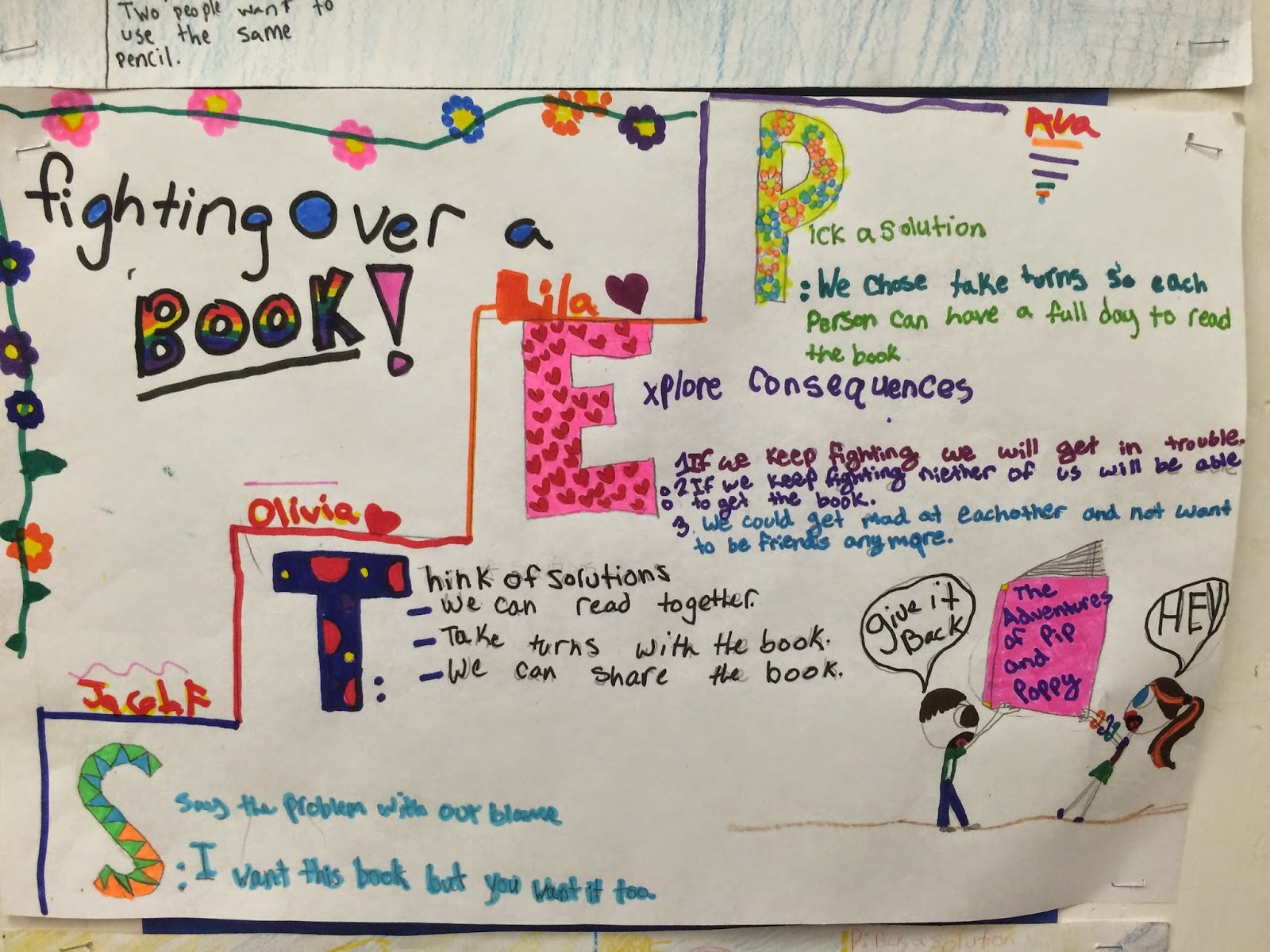
As part of our SEL curriculum through Second Step, students learn about the S.T.E.P. method for solving their everyday problems. The last 7 lessons in 4th grade are all about problem solving.
In these lessons students learn that following steps can help you solve problems and be successful at school. When you say the problem without blame and take responsibility for their part, problems can be resolved in a respectful way. Some solutions to problems are complicated and need a plan. Plans help you break down a big ask into smaller, more manageable parts. You are better able to resolve conflicts when you are able to calm down and use the Problem-Solving steps.
Students were placed into small groups and each described the steps they would use to solve common problems that occur during their school day. Here are the posters they created:
I stopped by the first grade teachers team meeting last week and asked them which social emotional skills their students are struggling the most with. All 3 teachers, almost in unison, replied with "SELF CONTROL!" So, I began searching for the best lesson in self control I could find...and I stumbled across an old favorite, The Marshmallow Test. It was a fascinating study done in the 1960s at Stanford University (if you google it there are tons of articles about it) where they had preschoolers sit in a room alone with a marshmallow for up to 20 minutes. If they ate it, that was all they got. If they waited until the researcher came back, they earned a second marshmallow. This longitudinal study predicted higher SAT scores, lower BMI scores and various other themes when they followed up with the students that waited for the second marshmallow. I wondered how our first graders would do with this marshmallow test. Who would eat the marshmallow? Who would wait? I had to do it. First, I checked our student's allergy list. Then, I came into each classroom and I simply explained the marshmallow test. You could choose to eat it now, or you could choose to wait until the end of my lesson (in 30 minutes) and receive a second marshmallow. I passed them out and began the hilarious video below:
While the video aired and students laughed, I watched to see how they were doing. Some were playing with their marshmallow, some hiding it under a tissue, one even zipped it up into their binder. After the video I introduced the topic: Self Control. What is self control? How do we know when we have self control? Is self control easy? We brainstormed ideas to help us with self control and I showed them this poster (found here):
I went through each step carefully and students modeled how they have shown self control in the past. Then I put them through a challenge to see how well they could show self control (in addition to those yummy marshmallows sitting on their desks). I explained that we were going to play Red Light, Green Light. But with a twist. We were doing it in the hallway. Yep, the hallway! A place where you are not allowed to talk and you are only allowed to walk. Their eyes grew big. Would they be able to play Red Light, Green Light and have the self control to stay in the game by following our hallway rules? Each class performed differently, but overall it was a success and we didn't make too much racket. When we came back into their classroom we celebrated by watching Cookie Monster's video about self control and had a mini dance party, with our marshmallows of course. When the time was up their eyes were anxiously looking up at me. Would I fulfill my end of the deal? Were they able to exhibit self control? The results were in as I walked around passing out a second marshmallow. All but 2 students were able to wait. One surprised me, one did not. Not too bad roadrunners...I'll get you next time.
Our SEL Department developed a Peace Path that students can use in the classroom to help resolve conflict with their peers. You can take a look of how it works as part of our Peace Areas at Lee Elementary here. While this is a great tool for students to use while they're in the classroom, students are left stranded out on the playground when they have conflict. After campuses inquired about how to translate these skills to the outdoor playgrounds, our SEL department created stencils to create a sidewalk Peace Path (thank you, thank you, thank you)! Here is a quick video I took walking through the Peace Path so you can see each of the steps. It took 3-4 hours over 2 days to create the finished product with two people, myself and Joelle Andrew - an amazing parent volunteer/super hero. :)
Our playground Peace Path provides students,
teachers and our entire campus a space and a method that is safe, sincere, and
easy to follow for conflict resolution. It is another effort towards
student empowerment to self-regulate and solve their problems. Ours is
strategically placed between 2 of our playgrounds and has already been a huge hit
with the Roadrunners!
Once completed I took out each class to teach them how to use it. We began by brainstorming common problems that happen with our friends out on the playground:
I had students pair up and brainstorm a "problem" to resolve with their partner, real or fake. Then we headed outside to practice!
Our Peace Path has been a huge success! Not only are teachers on board and helping students through conflict resolution steps at recess, but children are initiating its use during our aftercare program and kids have even been caught & featured on Instagram! Here are some individual shots of each step: