Thursday, September 18, 2014

3 Keys to Success


In fourth grade we learned the relationship between success in school and future success in a career.  Our students had a great time taking some job "tests" that I'm sure they'll bring home and try to trick their parents too!  This is one of my favorite lessons to do because the students get caught off guard and often tricked by the cleverness.  The lesson comes from "Puzzle Pieces" by Gwen Sitsch & Dian Senn.

I began by having students brainstorm a list of all the jobs and careers they could think of.  I read a description of mystery job, leading students to the realization that they do currently have a job - a student!

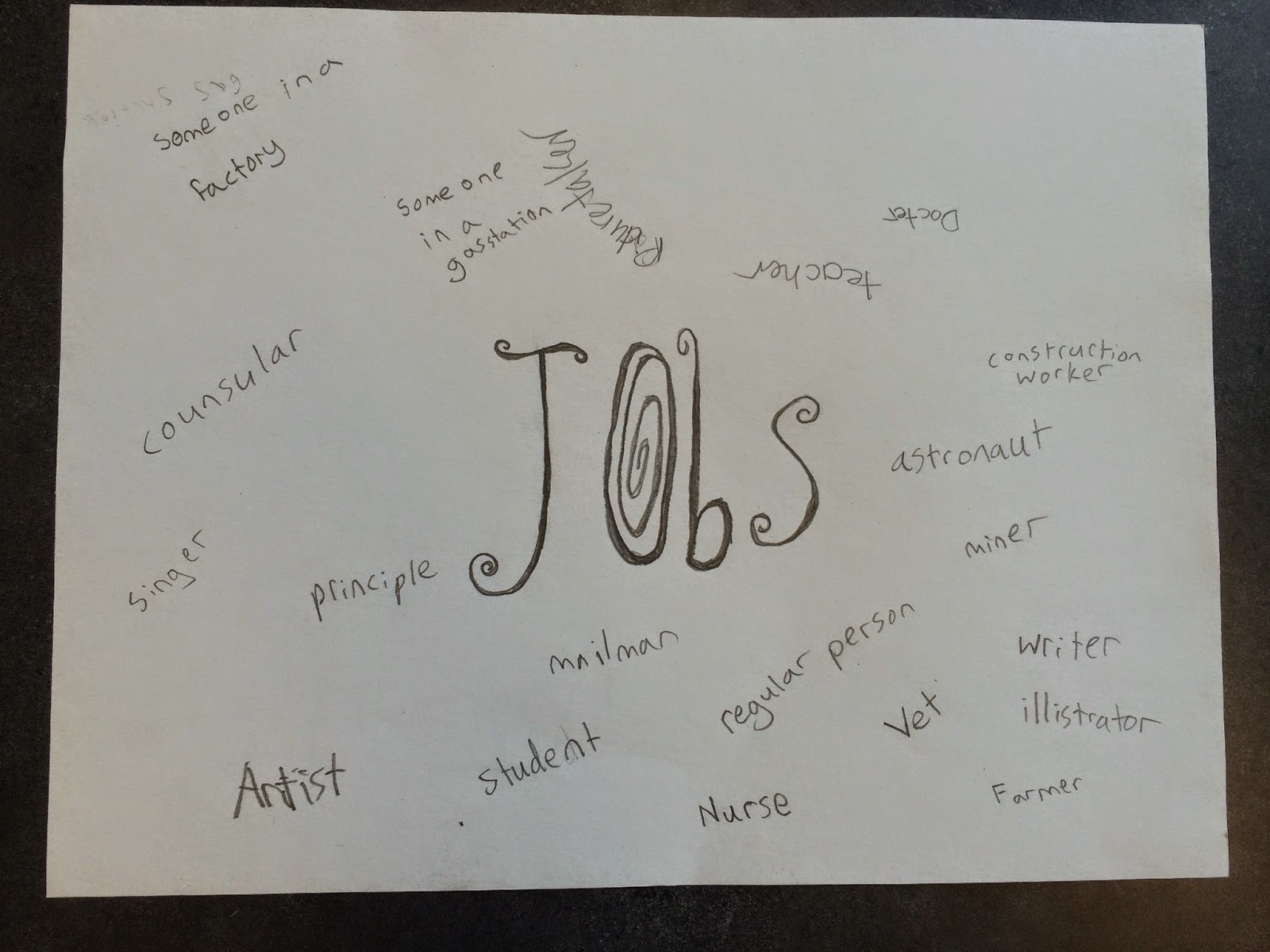

We then talked about behavior and about how repeated patterns of behavior can become habits.  Once a behavior becomes a habit, it can be difficult to break.  I used examples of habits that we could have right now that would greatly affect us later in life in a career or occupation - being late, failing to complete a task, speaking disrespectfully to authority, or not getting along with peers.

Students then learned about 3 keys to being successful at any job through a series of "tests."  The first test taught them about following directions.  The second test reinforced concentrating.  The third test emphasized thinking.  You cannot always go with your first impulse when answering a questions or performing a task.  Most times decisions require thought and concentration.


These ideas can help students not only in future careers but also in their current schoolwork.  School is the practice field for most of life's experiences, and students in fourth grade are at an age where they begin to realize that everything they learn is relevant and applicable to everyday life.


Tuesday, September 16, 2014

We Are Girls Conference


What is We Are Girls?

GENaustin’s We Are Girls Conference is a statewide annual event that helps girls explore the issues of bullying, body image and being a girl. Skill-building workshops and dynamic presentations are offered on topics including creating healthy relationships, building financial and media literacy, enhancing parent-daughter relationships and increasing positive body image, health, and wellness. Designed especially for girls in grades 3-12 and the adults who care about them, We Are Girls connects individuals with questions to the experts who have the answers.

Mentors @ Lee


In addition to our McCallum PALs, Lee Roadrunners are also welcoming Mentors to our campus!

Research indicates that youth participating in mentoring relationships:
  • Experience positive academic returns including better attendance, better attitudes towards school, and an increased likelihood of going on to higher education
  • Are less likely to initiate alcohol/drug use while being mentored and less likely to engage in some negative behaviors
  • Have more positive social attitudes and relationships
Austin Partners In Education mentors work one-on-one with Austin students during the school day. They help students improve their social and study skills, strengthen their communication skills, and build self-confidence. They inspire children to develop new interests, explore career possibilities, and achieve their personal and academic goals. Mentoring opportunities are available for students in any school and any grade within Austin ISD.

If you are interested in having a mentor for your child or know of someone who would be a positive mentor for our Lee Roadrunners, please contact Jaclyn Sepp at jsepp@austinisd.org or visit Austin Partners in Education at http://www.austinpartners.org/mentor

Monday, September 15, 2014

Monster Feelings

It is important to teach children that their bodies will feel different when they experience different feelings.  Explicitly teaching how their muscles, breathing and facial expressions change can help them understand what a strong feeling is like in their body.  In follow up lessons I will teach them techniques for handling strong emotions.

I typically start off our kindergarten lessons with Ed Emberley's Glad Monster Sad Monster.  This adorable book introduces students to many different feelings and includes masks inside the pages for you to "wear" and show students what the feeling might look like.  Each page describes situations that elicit a specific feeling.  I have students use the clues to guess what emotion will pop up on the next fold-out mask page.


I found free coloring pages of the different feelings expressed in the book that I turned into a mini-coloring books.  After the story each student received their own coloring book to reinforce the feelings we learned about.


Thursday, September 11, 2014

18 Questions to Ask on Back to School Night

Check out "18 Questions to Ask on Back to School Night" on CommonSense Media.  Get the answers you need about how media and technology will be used in your kids' education.


Wednesday, September 3, 2014

Talking to Your Child About A Tragedy


Tragedies happen every day around us in our world, countries, cities and schools.  Addressing death and the emotions that accompany tragedy can make a profound, positive impact on our children.  Parents, counselors, teachers and other school staff are key adults in many students' lives.  We must be ready to meet this challenge with knowledge and skills that will best serve our children to cope with these sad experiences.

Challenges for adults discussing tragedy with children include:
  • We are unsure what to say
  • We are uncomfortable about it ourselves
  • We feel the need to protect and shelter
  • We believe talking about it will create fears/anxieties
Even if we fail to talk to children and youth about tragedy, they learn about it from the world around them.  These "learnings" don't always promote the best understandings.  Cartoons, books, movies, fairy tales and video games, all present tragedy as reversible and avoidable.  In cartoons, death is a fate that only happens to the "bad" guys.  Honesty is the best policy when discussing tragedy, yet we are often afraid we will say "the wrong thing." 

Here are some guidelines that are important to discuss when it comes to explaining tragedy:
  1. Tell the truth.  Talk to your children about what happened in terms that are appropriate to their cognitive and developmental levels.  Accurate information is central to the child's ability to analyze events and draw personally relevant conclusions.
  2. Avoid giving unnecessary information that would only serve to distress or confuse the child.  Young children think very concretely.  Therefore, explain concretely what happened.  Out of their own anxiety, children will need to talk about the tragedy.  If they don't have accurate information, they may distort the truth.
  3. Allow for expression/affirm all expressions.  Offer your children the opportunity to share their feelings about the tragedy.  A child may say, "I'm glad it didn't happen to me."  That is a very honest response.  It should be affirmed, not as self-centered, but as honest.  If a child begins to cry, let them know that feeling sad at a time like this is very normal.  Crying over something that is very sad is different from acting like a baby.
  4. Set aside time for written expressions for the bereaved family/children.  Notes, letters or pictures created for the bereaved children mean a great deal.  Screen these projects.  Children's anxiety and fear can result in insensitive expressions.
  5. Plan for the bereaved children's return.  Guide your child in deciding what to say and how to act when the children return to school or activities within the community.  Although classmates and friends should not expect the bereaved children to want to talk about it, the subject should not be ignored.  In addition to a death in a family, it is devastating for the bereaved child to be abandoned by friends at school or community organizations, resulting in another loss.  Classmates and friends might acknowledge it with a statement like, "I'm glad you're back.  I am really sorry ___ happened" and then treat the children as they did before the tragedy.
  6. This loss may remind your children of losses they have experienced.  They may need to tell and retell the story of what has happened to them.  This helps them process, piece by piece, until they form their own developmentally realistic understanding.
  7. Maintain or assure daily activities and routines.  Regular activities help children pace their energy and feel safe.  Maintain rhythm, patterns and routines while tempering your expectations with kindness and understanding.
Please remember these difficult times affect everyone differently.  Please contact me if your child needs additional support coping with a loss.


Saturday, August 30, 2014

Rude vs. Mean vs. Bullying: Defining the Differences

I came across this thorough article written by Signe Whitson that helps explain the differences between being rude, being mean and bullying:

"A few weeks ago, I had the terrific fortune of getting to present some of the bullying prevention work that I do to a group of children at a local bookstore. As if interacting with smiling, exuberant young people was not gift enough, a reporter also attended the event a wrote a lovely article about my book and the work I do with kids, parents, educators and youth care professionals. All in all, it was dream publicity and since then, has sparked many conversations with people in my town who saw my photo in the newspaper and immediately related to the examples of bullying that were discussed.

I have been brought to tears more than once since the article ran, while listening to parents share their feelings of outrage and helplessness over their kids' experiences with bullying in school. One gifted but socially awkward middle school student blew me away with his articulate, poised, yet searingly painful accounts of relentless physical and verbal bullying on his school bus. An elementary school-aged girl described how she had to learn to shed her Australian accent within a month of entering U.S. schools because of how she was shunned by her classmates. The commonness of it all routinely astounds me with every new account; the pervasive cruelty makes my jaw drop every time.

It is important for me to begin this article by establishing that without doubt, many of the stories of bullying that are shared with me are horrifying and some are unspeakably cruel. But now, I also want to be honest and share that some of the stories are... well... really not so bad. 

Take this story recently shared with me by an acquaintance who read about my professional work:

"Signe, I saw your picture in the paper last week. Congratulations! I didn't know you worked with bullied students. It's so important that you do -- things have gotten so bad! Last week, my daughter was bullied really badly after school! She was getting off of her bus when this kid from our neighborhood threw a fistful of leaves right in her face! When she got home, she still had leaves in the hood of her coat. It's just awful! I don't know what to do about these bullies."
"Was she very upset when she got home?" I empathized.
"No. She just brushed the leaves off and told me they were having fun together," she said.
"Oh," I answered knowingly, aware that oftentimes kids try to downplay victimization by bullies from their parents, due to the embarrassment and shame they feel. "Did you get the sense she was covering for the boy?"
"No, no. She really seemed to think it was fun. She said that she threw leaves back at him, which I told her NEVER to do again! The nerve of those kids."
"Those 'kids,' I clarified. "Was it just the one boy throwing leaves or were there a bunch of kids all ganging up on her?"
"No, it was just this one boy that lives about a block from us," she assured me.
"Is he usually mean to her? Has he bothered her after school before?" I asked, eager at this point to figure out what the bullying issue was.
"No. I don't think so at least. That was the first time she ever said anything about him. It was definitely the first time that I noticed the leaves all over her coat. But it better be the last time! I won't stand for her being bullied by that kid. Next time, I am going to make sure the Principal knows what is going on after school lets out!"

While I always want to be careful not to minimize anyone's experience (it's the social worker in me!) and a part of me suspects that the sharing of this particular story may have been simply this parent's spontaneous way of making conversation with me in a store aisle, I hear these "alarming" (read: benign) stories often enough to conclude that there is a real need to draw a distinction between behavior that is rude, behavior that is mean and behavior that is characteristic of bullying. I first heard bestselling children's author, Trudy Ludwig, talk about these distinguishing terms and, finding them so helpful, have gone on to use them as follows:

Rude = Inadvertently saying or doing something that hurts someone else. 

A particular relative of mine (whose name it would be rude of me to mention) often looks my curly red hair up and down before inquiring in a sweet tone, "Have you ever thought about coloring your hair?" or "I think you look so much more sophisticated when you straighten your hair, Signe." This doting family member thinks she is helping me. he rest of the people in the room cringe at her boldness and I am left to wonder if being a brunette would suit me. Her comments can sting, but remembering that they come from a place of love -- in her mind -- helps me to remember what to do with the advice...
From kids, rudeness might look more like burping in someone's face, jumping ahead in line, bragging about achieving the highest grade or even throwing a crushed up pile of leaves in someone's face. On their own, any of these behaviors could appear as elements of bullying, but when looked at in context, incidents of rudeness are usually spontaneous, unplanned inconsideration, based on thoughtlessness, poor manners or narcissism, but not meant to actually hurt someone.
Mean = Purposefully saying or doing something to hurt someone once (or maybe twice).


The main distinction between "rude" and "mean" behavior has to do with intention; while rudeness is often unintentional, mean behavior very much aims to hurt or depreciate someone. Kids are mean to each other when they criticize clothing, appearance, intelligence, coolness or just about anything else they can find to denigrate. Meanness also sounds like words spoken in anger -- impulsive cruelty that is often regretted in short order. Very often, mean behavior in kids is motivated by angry feelings and/or the misguided goal of propping themselves up in comparison to the person they are putting down. Commonly, meanness in kids sounds an awful lot like:
• "Are you seriously wearing that sweater again? Didn't you just wear it, like, last week? Get a life."
• "You are so fat/ugly/stupid/gay."
• "I hate you!"

Make no mistake; mean behaviors can wound deeply and adults can make a huge difference in the lives of young people when they hold kids accountable for being mean. Yet, meanness is different from bullying in important ways that should be understood and differentiated when it comes to intervention.

Bullying = Intentionally aggressive behavior, repeated over time, that involves an imbalance of power.

Experts agree that bullying entails three key elements: an intent to harm, a power imbalance and repeated acts or threats of aggressive behavior. Kids who bully say or do something intentionally hurtful to others and they keep doing it, with no sense of regret or remorse -- even when targets of bullying show or express their hurt or tell the aggressors to stop.

Bullying may be physical, verbal, relational or carried out via technology:

• Physical aggression was once the gold standard of bullying-- the "sticks and stones" that made adults in charge stand up and take notice. This kind of bullying includes hitting, punching, kicking, spitting, tripping, hair pulling, slamming a child into a locker and a range of other behaviors that involve physical aggression.

• Verbal aggression is what our parents used to advise us to "just ignore." We now know that despite the old adage, words and threats can, indeed, hurt and can even cause profound, lasting harm.

• Relational aggression is a form of bullying in which kids use their friendship--or the threat of taking their friendship away--to hurt someone. Social exclusion, shunning, hazing, and rumor spreading are all forms of this pervasive type of bullying that can be especially beguiling and crushing to kids.

• Cyberbullying is a specific form of bullying that involves technology. According to Hinduja and Patchin of the Cyberbullying Research Center, it is the "willful and repeated harm inflicted through the use of computers, cell phones, and other electronic devices." Notably, the likelihood of repeated harm is especially high with cyberbullying because electronic messages can be accessed by multiple parties, resulting in repeated exposure and repeated harm. 

So, why is it so important to make the distinction between rude, mean and bullying? Can't I just let parents share with me stories about their kids? 

Here's the thing; in our culture of 24/7 news cycles and social media sound bytes, we have a better opportunity than ever before to bring attention to important issues. In the last few years, Americans have collectively paid attention to the issue of bullying like never before; millions of school children have been given a voice, 49 states in the U.S. have passed anti-bullying legislation, and thousands of adults have been trained in important strategies to keep kids safe and dignified in schools and communities. These are significant achievements. 

At the same time, however, I have already begun to see that gratuitous references to bullying are creating a bit of a "little boy who cried wolf" phenomena. In other words, if kids and parents improperly classify rudeness and mean behavior as bullying -- whether to simply make conversation or to bring attention to their short-term discomfort -- we all run the risk of becoming so sick and tired of hearing the word that this actual life-and-death issue among young people loses its urgency as quickly as it rose to prominence. 

It is important to distinguish between rude, mean and bullying so that teachers, school administrators, police, youth workers, parents and kids all know what to pay attention to and when to intervene. As we have heard too often in the news, a child's future may depend on a non-jaded adult's ability to discern between rudeness at the bus stop and life-altering bullying.

Signe Whitson is a licensed therapist, national educator on bullying, and author of three books including Friendship & Other Weapons: Group Activities to Help Young Girls Cope with Bullying. For more information or workshop inquiries, please visit www.signewhitson.com"