Showing posts with label learning style. Show all posts

Monday, February 2, 2015

Habit 6: Synergize

I have been waiting to teach Habit 6 to our fifth graders because team building activities are my favorite activities to do with groups of kids!  Habit 6 is all about the we, not the I.

Together Is Better:

I value other people’s strengths and learn from them. I get along well with others, even people who are different than me. I work well in groups. I seek out other people’s ideas to solve problems because I know that by teaming with others we can create better solutions than anyone of us can alone. I am humble.

To begin, we each did a personality assessment that I found available to download here.  Students rank themselves on the qualities they feel are most important to them across each row.  It is important to learn about your own strengths and weaknesses so you can function best in a group.  It is also important to learn about your group member's strengths and weaknesses so you can function best in a group.


After we all figured out which "fruit" best described our personality, I told them which fruit they would be paired up with for a group challenge.  They read through their partner's descriptions to think about ways that would improve their teamwork and communication skills.  Then I introduced the challenge...the LEANING TOWER OF FEETZA!


I found this free activity on a great website filled with team building activities, Playmeo.  I typed up a quick synopsis to explain the goal of the activity, and with such a simple task (or so we all had thought), I set them off to start right away!


Hilarity ensued, conflict ensued, problem solving ensued, chaos ensued!  We all had a really great time and an even better debrief session on the challenge, on synergizing and on how knowing more about ourselves can make such a different in our everyday interactions with others.

Thursday, September 18, 2014

3 Keys to Success


In fourth grade we learned the relationship between success in school and future success in a career.  Our students had a great time taking some job "tests" that I'm sure they'll bring home and try to trick their parents too!  This is one of my favorite lessons to do because the students get caught off guard and often tricked by the cleverness.  The lesson comes from "Puzzle Pieces" by Gwen Sitsch & Dian Senn.

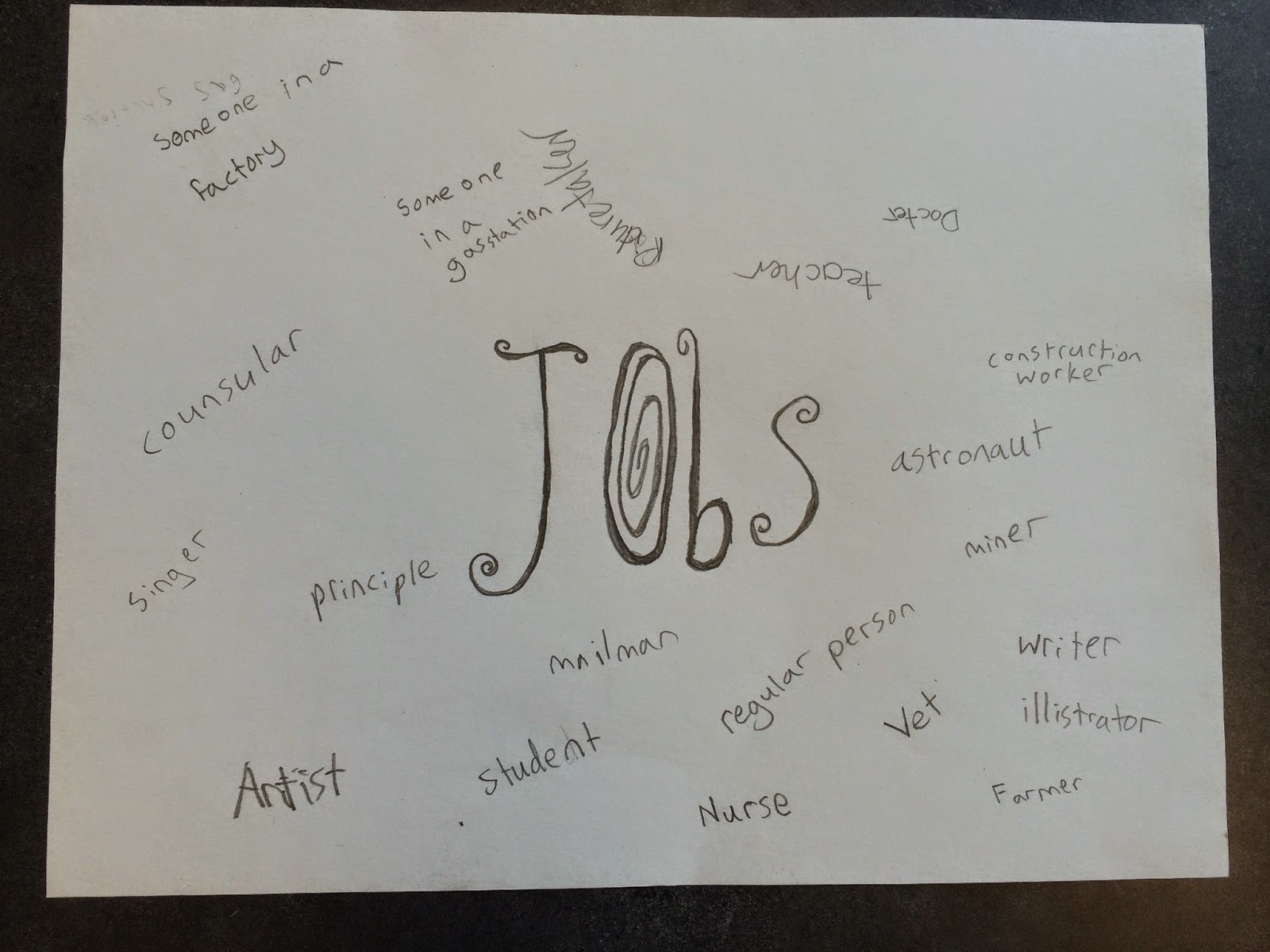
I began by having students brainstorm a list of all the jobs and careers they could think of.  I read a description of mystery job, leading students to the realization that they do currently have a job - a student!


We then talked about behavior and about how repeated patterns of behavior can become habits.  Once a behavior becomes a habit, it can be difficult to break.  I used examples of habits that we could have right now that would greatly affect us later in life in a career or occupation - being late, failing to complete a task, speaking disrespectfully to authority, or not getting along with peers.

Students then learned about 3 keys to being successful at any job through a series of "tests."  The first test taught them about following directions.  The second test reinforced concentrating.  The third test emphasized thinking.  You cannot always go with your first impulse when answering a questions or performing a task.  Most times decisions require thought and concentration.


These ideas can help students not only in future careers but also in their current schoolwork.  School is the practice field for most of life's experiences, and students in fourth grade are at an age where they begin to realize that everything they learn is relevant and applicable to everyday life.

Thursday, May 22, 2014

Learning to Relax with GoNoodle


I've been using GoNoodle each week with our kindergarteners to give them brain breaks (see post here).  They have become obsessed with helping their creatures grow by all of their minutes of dancing...and I'll admit...I have too!  This week I wanted to try some of the calmer videos that focus on breathing and relaxing.  I've been reading a lot about mindfulness, preparing ourselves to attend to what's going on in the moment, and figured I'd give it a try with my little friends.

I used Safe and Calm (3:43) on GoNoodle to get our bodies in a relaxed state ready to learn.  It has clouds that slowly drift across the screen as a calming voice directs you to lay down, close your eyes, belly breathe, and relax different parts of your body.  It was a neat experience to see a room of kindergarteners so relaxed and thanking their hands for all they do (which made myself and their teacher chuckle when some students actually told their hands "thank you").


Afterwards we moved to sit in a circle all facing the same direction.  I guided them through a free awareness activity I found online at Yoga Calm where we drew on each others backs:
  • Place your hands on the back of the person in front of you
  • Begin by making rain on the person's back - gently tapping with your fingertips
  • Now, make it rain all the way down their back - fingers sliding gently up and down their back
  • Then, there is very light thunder - gently tap on their back
  • Then, lightning - draw some long lightning strikes
  • Now, draw big puffy rain clouds
  • Brush those clouds away - gently sweeping your hands across their back
  • Now, the sun comes out - draw a big sun with a happy face and sunglasses
  • Then, place your palms on their back, close your eyes, and feel the warm hands.  Imagine yourself on the beach with the sun warming you
  • When the sun comes out the flowers begin to grow and a rainbow forms - draw these for your friend
  • Now, draw either a gift or a secret message on their back.  See if they can guess what you wrote 
I thanked them all for being so respectful to each other during each of the activities and rewarded them with some free GoNoodle stickers I received in the mail.


Thursday, May 1, 2014

GoNoodle ROCKS!


I came across this AMAZING site on Pinterest when looking for brain breaks.  It is free & easy to navigate and SO MUCH FUN!!!  You create an account and can make different classes, which is perfect for me as a counselor.  For each class you pick an avatar that grows and changes the more time you spend doing brain breaks.


There are so many options available depending on your class needs: calming, energizing, just a break, refocusing, anger management, de-stressing, etc.  Some of the videos coached you through different moves, some were karaoke style, others tested listening skills, and some facilitated free styling.  I tested out a bunch with my kindergarten classes and we had a blast.  I first started with a discussion of personal space bubbles.  Students learned that if they bent, stretched, kicked, or flailed their arms in any direction they should not touch anyone.  If we accidentally popped someone's bubble, we were to apologize and then move where you could have more space.  Then we all moved to our dancing positions and began!


I had pre-selected different brain breaks and watched them ahead of time to see if they were appropriate for my goal.  The ones we did were Freeze It: Emotions, Exercise Like a Rock Star, Dancing Robots, Dinosaur Stomp, Ants in Your Pants, Happy, and Let It Go.  Here are a couple shots of us in action:


Wednesday, March 26, 2014

Austin ISD: A District Embracing SEL


Austin students learn social-emotional “survival” skills

As with most large school districts, Austin Independent School District’s 87,000 students are culturally and economically diverse and, in some cases, working to succeed despite difficult circumstances. 

As part of their effort to help all their students succeed, AISD is implementing a 5-year initiative to implement social-emotional learning (SEL)—including the Second Step program--in every school. And their efforts are already paying off. 

For example, in the three years since O. Henry Middle School began implementing SEL, discipline referrals in the first six weeks of school have dropped by 87 percent. 

AISD educators and students alike love the program. Says third-grader Isabelle, “Some schools probably don’t do Second Step or social-emotional learning, and their school’s probably not as fun as ours.” 

Check out the video here or below.

Monday, March 17, 2014

Making Mistakes

I think this article from NPR highlights such an important part of the learning process: making mistakes.  Students are often afraid to make mistakes and will back down from a challenge when there is potential to not succeed the first time.  We, as adults, often jump in to save/protect/solve children's problems for them in order to prevent them from experiencing the feeling of failure.  I believe that children need to be encouraged to try their best and see that making mistakes while they're young better prepares them for the future.  I recently purchased Mistakes That Worked written by Charlotte Foltz Jones to help children understand that mistakes are okay to make.  How do you feel after reading this article?


Does Teaching Kids To Get 'Gritty' Help Them Get Ahead?

by Tovia Smith
 At the Lenox Academy in Brooklyn, N.Y., educators try to teach kids to see struggle as a normal part of learning.

It's become the new buzz phrase in education: "Got grit?"
 
Around the nation, schools are beginning to see grit as key to students' success — and just as important to teach as reading and math.

Experts define grit as persistence, determination and resilience; it's that je ne sais quoi that drives one kid to practice trumpet or study Spanish for hours — or years — on end, while another quits after the first setback.

"This quality of being able to sustain your passions, and also work really hard at them, over really disappointingly long periods of time, that's grit," says Angela Duckworth, a psychology professor at the University of Pennsylvania who coined the term "grit" — and won a MacArthur "genius grant" for it.

"It's a very, I think, American idea in some ways — really pursuing something against all odds," she says.

Duckworth says shows grit is actually a better predictor of success than IQ or other measures when it comes to achievements as varied as graduating from West Point or winning the National Spelling Bee.

Even the Obama administration is now on the "grit" bandwagon. A from the Department of Education laments that kids are learning to "do school," but aren't learning the skills they need in life.


But can grit be taught?

"I hope so," says Duckworth, "but I don't think we have enough evidence to know with certainty that we can do so." Part of the problem is figuring out how to assess grit. Duckworth says "these things are really hard to measure with fidelity."
Even so, many schools around the nation have embarked on their own experiments — they see the promise of the concept as too great to wait.


Students play a math game at the Intellectual Virtues Academy in Long Beach, Calif. The charter middle school stresses grit, intellectual courage and curiosity.
Courtesy of Jacquie Bryant
 
Letting Kids 'Hit The Wall'
Jason Baehr, a philosophy professor at Loyola Marymount University, recently launched the Intellectual Virtues Academy in Long Beach, Calif. It's a charter middle school that's a kind of petri dish for grit, along with other so-called virtues like intellectual courage and curiosity.

"This is all anecdotal at this point," Baehr says. "But I'll say from our experience in the school, I see [kids learning to be grittier] all the time. ... You can create a classroom culture in which struggle and risk-taking is valued more than just getting the right answer."

One way to make kids more tenacious, the thinking goes, is to show them how grit has been important to the success of others, and how mistakes and failures are normal parts of learning — not reasons to quit.

That message underlies every lesson at the Lenox Academy for Gifted Middle School Students in Brooklyn, N.Y., a public school that has been trying to make kids grittier for the past three years. On a recent day, in a typical lesson, a social studies class is studying Steve Jobs. Kids raise their hands to offer examples of Jobs' grit.

"He had failed one of the Mac projects he was creating," says one student.

"He used his mistakes to help him along his journey," says another.

Students also get to practice being gritty themselves. When a kid struggles to answer a question, for example, teachers resist the urge to swoop in and offer hints. Instead, they let students squirm a little through an awkward silence. The idea is to get kids comfortable with struggle so they see it as just a normal part of learning.

Tom Hoerr leads the New City School, a private elementary school in St. Louis, Mo., that has also been working on grit. "One of the sayings that you hear around here a great deal is, 'If our kids have graduated from here with nothing but success, then we have failed them, because they haven't learned how to respond to frustration and failure.' "

After years of focusing on the theory known as "multiple intelligences" and trying to teach kids in their own style, Hoerr says he's now pulling kids out of their comfort zones intentionally.

"The message is that life isn't always easy," Hoerr says. His goal is to make sure "that no matter how talented [students are], they hit the wall, so they can learn to pick themselves up, hit the wall again and pick themselves up again, and ultimately persevere and succeed."

It is a major adjustment for everyone — perhaps most of all for parents. "It's really easy to talk about in the abstract," Hoerr says. "Parents love the notion of grit; they all want their kids to have it. However ... no parent wants their kid to cry."


Changing Mindsets To Help Kids Persevere 

In order to get parents and kids on board with the idea of struggle, educators say, they first need to be convinced that their struggle is likely to pay off. Or, as Stanford University professor Carol Dweck puts it, they need to have a "growth mindset" — the belief that success comes from effort — and not a "fixed mindset" — the notion that people succeed because they are born with a "gift" of intelligence or talent.

"It's really hard to have high tolerance if you believe that your abilities or intelligence are fixed," says Eduardo Briceno, CEO of Mindset Works, a company he co-founded with Dweck. "Because if you believe 'I can't change my own abilities,' then trying hard doesn't make any sense. It's like pounding your head against the wall."

Indeed, educators say they see it all the time: Kids with fixed mindsets who think they just don't have the "gift" don't bother applying themselves. Conversely, kids with fixed mindsets who were always told they were "gifted" and skated through school tend to crumble when they hit their first challenge; rather than risk looking like a loser, they just quit.

"Kids came to our middle school, and when that curriculum got tough, a majority of them retreated," says Joe Giamportone, assistant principal of Lenox Academy. "Performance declined over the course of three years."

Seventh-grader Jamal Parris is typical. After arriving at Lenox Academy, he began to struggle in math.

"I started thinking that I wasn't that smart and I didn't deserve to make it into this school," says Parris. "When I was in fifth grade, I used to be so good at math. And then when I came to Lenox Academy, like, I just hit a wall. I was like, 'Whaaat? Letters in math?!'
"I couldn't understand anything," he continues. "Some days I wouldn't even go home to study, because I was like, 'I'm just gonna get a low grade anyway, even if I study.' "

That's what launched Giamportone on a kind of crusade three years ago to root out that kind of fixed mindset. Since then, he says, everyone at school has done such a mental and cultural 180 that even the very name of the Lenox Academy for Gifted Middle School Students is like a dirty word.

"We don't use the word 'gifted' — ever," Giamportone says. "In our school, you will never hear it."

" 'Smart' is like a curse," adds social studies teacher June Davenport.

Instead, the school is plastered with signs and handmade posters promoting a "growth mindset."

"This is a term in every class: 'Use the growth mindset. Have the growth mindset,' " says eighth-grader Alina Blaze. "You can put forth the effort to get something that you want."
The message is not unlike what Grandma always said: "You can do anything," "Just practice, practice, practice," and, "Don't give up!" But Blaze says what convinced her was the science.

The Mindset Works curriculum starts with Brainology, a kid-friendly computer-animated crash course in how the brain works like a muscle; the more you use it, the stronger it gets.

"I learned how, every single day, the more you learn things, the more neurons that pop out of your brain," says sixth-grader Nyashka Laurore. Even after a few lessons, she says, she stopped feeling like school was just something she couldn't do.


Christa Quint teaches a math class at the Lenox Academy. Teachers at the school resist the urge to offer hints when a student struggles with a question.

Changing Approaches In The Classroom
The focus is always more on putting out effort than on getting the right answers. Teachers have been trained to change the way they see students, and how they speak to them.

Kids no longer hear "You're so smart!" or "Brilliant!" Rather, teachers praise students for their focus and determination. "You must have worked really hard!" or "To have performed this well, you must have put out a lot of effort."

The adjustment isn't always easy for teachers trained to focus on hitting high scores on standardized tests. "It's really hard in certain subject areas to say that your process is more important than your product," says science teacher Nicole Trubnikov. "But that is the underlying principle of this program — to say that it's all the effort that you put in that's most important."

Some schools even grade students on "growth mindset" and "grit." It doesn't make it onto report cards at Lenox, but kids do get evaluated on it in class by teachers — and by other kids. 

In one history class, for example, eighth-graders observe their classmates discussing a reading passage, and then rate them on things like "learning from past mistakes."

"Normally, Timothy, he likes to talk to his friends outside of the group and, like, interrupt, and he don't pay attention that well, but he's able to take charge," offers one student.

"If I was an outsider and I was hearing this conversation, I might think that this was some kind of hippie-dippy love fest," concedes the teacher, Nathan Cearley. "But what you see is actually a more rigorous and risky learning environment."

In three years, Cearley says, he's seen kids grow less afraid of making mistakes, and more willing to ask for help. Test scores at Lenox have jumped 10 to 15 points.


Teacher Cari Noble asks students to discuss quotes about risk-taking at Intellectual Virtues Academy.

The Latest Fad In Education?
The number of schools using Brainology is expected to double this year, from 500 to 1,000. But even Briceno concedes they are still just small islands in a culture that may give lip service to earning an "A for effort," but that still rewards grades and scores above all.

Angela Duckworth, the grit guru who's also experimenting with making middle-schoolers grittier, agrees. A limited intervention, she says, if not consistently reinforced in and out of school, can only have limited results. "We don't know whether we've had any effect — the jury's out," says Duckworth. "It just seems to me extremely implausible that that's going to permanently and impressively change a child."

Indeed, even after three years at Lenox Academy, sometimes all it takes is one bad test score for kids to lapse back into the old mindset of "I'm just not good at math."
"Grit as a goal seems to be multiply flawed and very disturbing," says education writer Alfie Kohn. For starters, he says, "the benefits of failure are vastly overstated, and the assumption that kids will pick themselves up and try even harder next time, darn it — that's wishful thinking."

Kohn sees the focus on grit as just the latest fad in education that will soon "burn itself out," like many have before. He doesn't believe that kids today are any less gritty than before. And he says the research showing that gritty people tend to be more successful doesn't really offer any new insight. As Kohn put it, "It's a pure circular assumption, like persistent people persist."


Besides, Kohn says, if there's a problem with how kids are learning, the onus should be on schools to get better at how they teach — not on kids to get better at enduring more of the same.

"Grit's taken off as a fad in education, because that's a convenient distraction that doesn't address the pedagogical and curricular problems in the schools," he says. "But the more we focus on [grit] ... the less likely it is that we make the kind of changes that can help our children go to better schools."

Some have also raised concerns about grading kids on grit and with calling grit a "good character trait" or a "virtue." As University of Pennsylvania education professor Joan Goodman puts it, those are very loaded words with moral overtones.

"The language is important, because you're talking about virtues, you're talking about character, and ... you don't want to generate the notion that you are a bad kid if you are not gritty, and you're a good kid if you are," says Goodman.

Besides, Goodman says, grit may not be a character trait at all, but rather a byproduct of other traits, like confidence, courage and curiosity. And, she says, people can be gritty in some things but not others. A kid might be passionate about chess, for example, but completely disengaged in chemistry class.

That's a point well taken by Duckworth. She agrees that schools, teachers and parents all share in the responsibility to help inspire kids so they're intrinsically motivated.
"I don't think people can become truly gritty and great at things they don't love," Duckworth says. "So when we try to develop grit in kids, we also need to find and help them cultivate their passions. That's as much a part of the equation here as the hard work and the persistence."

It's a little bit of a chicken-and-egg kind of question. Passion may drive kids to be gritty, but being gritty and able to tolerate failure also enables kids to develop and pursue a passion.

Just ask eighth-grader Alina Blaze. Several years ago, she quit the viola out of fear that she would embarrass herself. "I found it so difficult to learn, and I said, 'I'm just not good at this, so I might as well not try,' " she says. "And soon enough, I just put my viola up there on top of the closet, and that was the end of that."

But now, three years into the growth-mindset training at Lenox Academy, Blaze says, she believes "you can teach old dogs new tricks."

"I think that if I just put in enough effort I can be the next Yow Ming," she declares. As her classmates begin to giggle beside her, she stammers, "I mean, Yo-Yo Ming. I mean, Yo-Yo Ma!"

Mistakes like that one will always be embarrassing, Blaze says. But now, she recovers more easily. She's one who got the message, as they say around here, that the secret to success is failure.

Monday, January 27, 2014

GT Elementary Student Games Day & Parent Networking Event

Austin Independent School District

Advanced Academic Services Presents

GT Elementary Student Game Day & Parent Networking Event


Saturday, February 8, 2014 
9:00 – 11:00 a.m. 
Baker Center Cafeteria 
3908 Avenue B 
Austin, TX 78751 

Kids, bring your favorite board game or card game and join other GT students in having some fun! 

Parents, spend time networking with other GT parents. If you can, bring your laptop or tablet so you can explore Austin ISD GT resources.


Thursday, October 10, 2013

Keys to Success in 4th Grade

 
Each year I LOVE to do this lesson with my fourth graders!  It comes from Puzzle Pieces, a guidance lesson book full of relevant lessons for my students.  This lesson helps students learn the relationship between success in school and future success in a career.  The students had a great time taking some job "tests." ;)

I began the lesson by having students name as many jobs as they could think of.  This led the students to the realization that they do currently have a job - school.  We then talked about behavior and about how repeated patterns of behavior can become habits.  Once a behavior becomes a habit, it can be difficult to break.  Habits tend to influence our reputation.  I used examples of habits that students could have right now that would greatly affect them later in life in a career or occupation - being late, failing to complete a task, speaking disrespectfully to authority, or not getting along with peers.

Students then learned about three keys to being successful at any job.  The first is following directions.  Be sure to ask your child if you can see their following directions test.  The second key is concentrating.  The third key is to think before any choice.  Your child will most likely try to trick you with their extra copy of "Job Test Number Three."  The point of this test is that you cannot always go with your first impulse when answering a question or performing a task.  Most times decisions require thought and concentration.

These ideas that we discussed in class can help students not only in future careers but also in their current schoolwork.  School is the practice field for most of life's experiences, and your child is at an age where realizing that everything they are learning is relevant and applicable to everyday life is crucial.


Thursday, May 23, 2013

We Can Do It!

With the school year coming to a close, I wanted students to reflect on their experiences and start looking forward to the future.  I read Cloudette by Tom Lichtenheld to show them that we all make a difference by our actions.  This delightful story shows the transformation of a small cloud that feels that she can't do what other clouds are able to accomplish because of her small size.

After reading the story aloud, we brain"stormed" (hehehe) the message the author was trying to teach us.  We all gained a feeling that we can do anything if we put our minds to it.  I then had students create a flip book demonstrating what they wanted to accomplish in the next school year.  Using the year 2013, they came up with:
  • 2: two goals I have for next school year (academic, social, behavioral)
  • 0: something I'd like to stop doing (habits, choices)
  • 1: one thing I am worried about
  • 3: three new things I'd like to learn/try


Monday, April 1, 2013

5th Grade STAAR Secrets

STAAR testing is a time of the year where many students develop higher levels of anxiety.  Although they have been practicing and are fully prepared to do their personal best, the looming accountability is scary.  With my fifth graders I started by giving them a Test Anxiety Questionnaire I found on Marissa's Elementary School Counseling Blog.  There are 10 statements that students rank on a scale of 1-5, never-always.  Afterward they add up their scores to see their level of anxiety.  Most students ranked low to medium levels, but there were a few students that had an unhealthy level of test anxiety that I met with privately later in the week.


We then created acrostics using the letters in our first names to describe testing strategies that we found successful to use.  I saw this idea on Working 4 the Classroom blog and adapted it for our needs.  I provided students with construction paper and foam letters to be creative.  Here is my example:


Here are excerpts from students (to keep their names confidential):


Friday, March 8, 2013

Working Through Spring Fever

Winter has come to an end and springtime is finally here.  Your children are tired of wearing heavy coats and having indoor recess.  While they would much rather think about summer vacation and playing outside than concentrating on homework, the school year is not over yet!  You can help your child WORK THROUGH SPRING FEVER by understanding basic motivation in children, being involved in their learning, and knowing ways to redirect them.
Motivating Characteristics:
  • PERSISTENCE is the ability to stay on task for a period of time.  There are measurable differences in children's abilities to engage in activities.  A highly motivated child will stay involved for a long period of time, whereas an unmotivated child will give up very easily when not instantly successful.  Children learn persistence when they are successful at a challenging task.  Parents can help build persistence by offering tasks that are just challenging enough, but not overwhelming.
  • CHOICE OF CHALLENGE is a characteristic of motivation.  Children who meet a challenge will feel success and welcome another appropriate challenge.  Unmotivated children, those who have not experienced early success, will pick something that is very easy and ensures an instant success.  These children feel only low success because they know the task was not challenging.  Parents can help their child find an appropriate challenge while still allowing the choice to be the child's.
  • The AMOUNT OF DEPENDENCY ON ADULTS is another indicator of motivation.  Children with strong intrinsic motivation do not need an adult constantly watching and helping with activities.  Children who have a lower lever of motivation or are extrinsically motivated need constant attention from adults and have great difficulty functioning independently.  Independence is an important aspect of quality learning.  Too much dependence on adults can limit a child in school.  Parents can increase independent motivation by encouraging activities that require curiosity and creativity.  This encourages children to invent their own worlds rather than depending on an adult to entertain them.
  • EMOTION is also an indicator of motivation.  Motivated children will have a positive display of emotion because they are satisfied with their work and show more enjoyment in the activity.  Children without appropriate motivation will appear quiet, sullen and bored.  They will not take any apparent pleasure in their activity and will often complain.  As a parent, you are probably the best judge of your child's moods.

Wednesday, January 9, 2013

Learning Styles

In fourth grade this week we are discussing the different ways we learn.  We talked about why it is important to know how we learn in order to advocate for ourselves and use the best studying techniques for our style to be successful in school and life.  Students made a flip book that described the 3 different learning styles: visual, auditory, and kinesthetic.  On the outside they labeled the three types with pictures and on the inside they detailed helpful strategies.


We then took a survey to find statements that described our learning style in the classroom.  We discussed which statement matched up with each learning style to tally our own unique results.  Finally I had students explain the ways in which I taught to all 3 styles during our lesson today.