Thursday, January 16, 2014

Tough: The Bully


Continuing with the series of Erin Frankel's books, we read Tough.  This story is told from the aggressor's perspective.  Students learned the reasoning behind Sam's mean behavior toward others at school.  Students in fourth grade created posters to hang around the school to teach other students what they can do if they witness bullying:


Tuesday, January 14, 2014

Parent Training on Jan 14, 2014: Bullying

Below are the slides from a 30-minute parent training I presented on January 14, 2014.  There is an additional packet that follows along with the powerpoint and provides additional resources.  If you are interested in more information, please don't hesitate to contact me.


Thursday, January 9, 2014

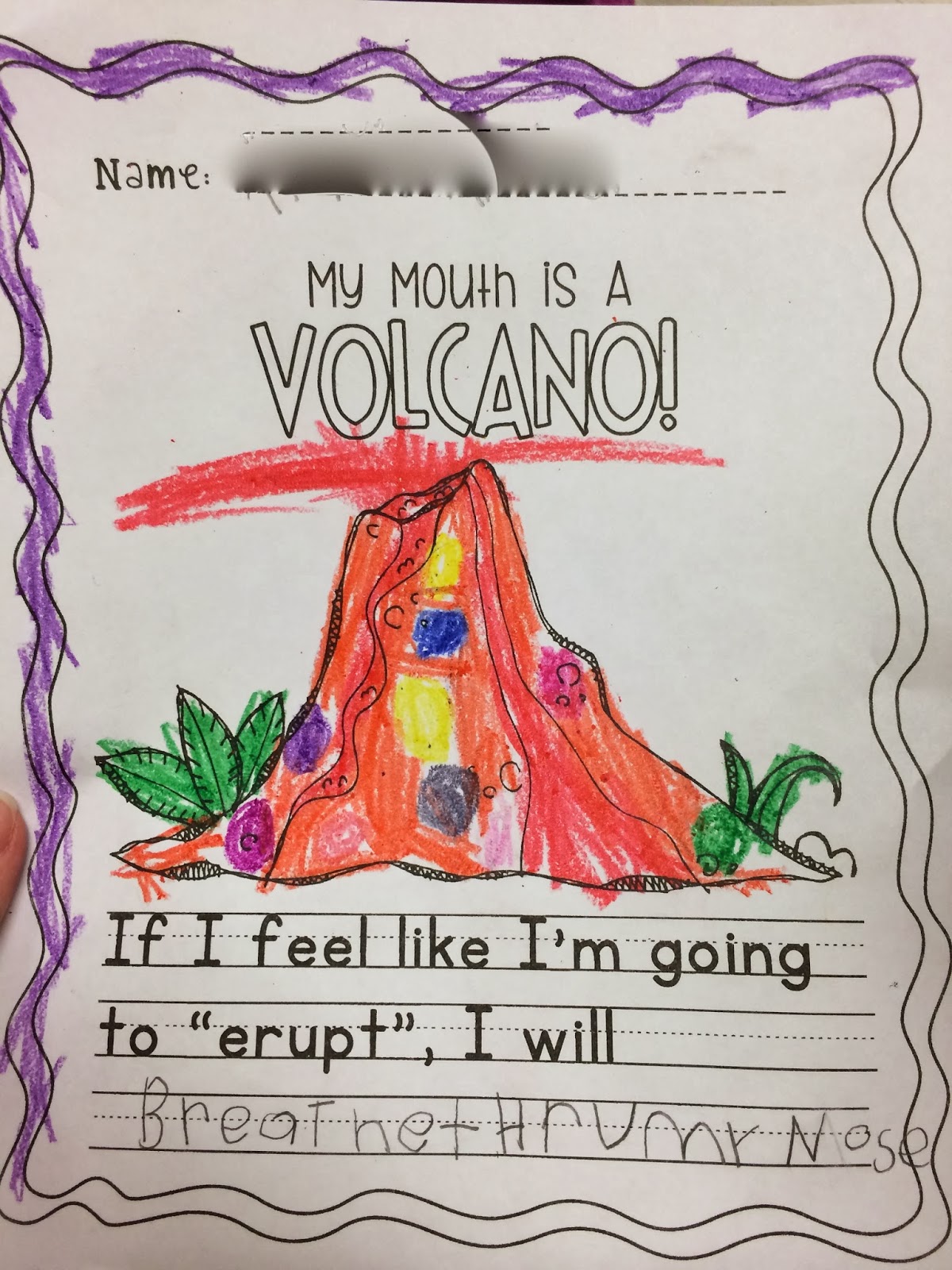
My Mouth is a Volcano


Although we may initially think that children are being rude when they interrupt, they actually just don't know any better.  Developmentally, young children are just starting to figure out that there is more going on in life than themselves.  Because of their egocentric thinking, children just blurt out what pops into their mind without a further thought.

In kindergarten we read "My Mouth is a Volcano" by Julia Cook.  She uses a volcano erupting as a reference to our voices interrupting.  We meet Louis who has lots of exciting things to share throughout the day, but ends up in time out over and over because of his constant "erupting."  Through a cute rhyme, we can picture Louis' words building up steam before they "erupt" out of his mouth at the wrong times.  Once Louis is interrupted by his fellow classmates, he is confronted with how other people feel when he does the same, and is able to develop empathy.

After the story, we reviewed ways to help us not "erupt" and brainstormed some of the way we already us successfully.  Ideas included: wait our turn, raise our hand, take a deep breath, gulp down our words, bite down hard so our words don't escape, breathe out our words then suck them back in at the right time, etc.  Students wrote out their plan to prevent interrupting and enjoyed making their volcanoes erupt on their paper.


Wednesday, January 8, 2014

Celebrate Kindness: No Name-Calling Week 2014


I am writing to tell you about an exciting week that is quickly becoming a yearly tradition at Lee Elementary.  No Name-Calling Week was inspired by a young adult novel entitled The Misfits by popular author James Howe.  The book tells the story of a group of friends trying to survive the seventh grade in the face of all too frequent taunts based on their weight, height, intelligence, and gender.  Motivated by the inequities they see around them, the “Gang of Five” (as they are known) creates a new political party during student council elections and runs on a platform aimed at wiping out name-calling of all kinds.  They win the support of the school’s principal for their cause and their idea for a “No Name Day” at school.
Motivated by this simple yet powerful idea, a coalition of over forty education, youth advocacy, and mental health organizations have partnered to organized an actual No Name-Calling Week in schools across the nation annually.  The project seeks to focus national attention on the problem of name-calling in schools, and to provide students and educators with the tools and inspiration to launch an ongoing dialogue about ways to eliminate name-calling in their communities.

At Lee Elementary, we recognize the importance of building empathy and teaching respect to our students, and note the impact words can have on their well-being.  A recent survey conducted by the U.S. Department of Health and Human Services reports that students aged 9 to 13 consider name-calling the worst kind of verbal bullying, and that threatening words or taunting based on race or appearance have as much negative impact as does physical bullying.  According to the study, students who regularly experience verbal and non-verbal forms of bullying report hurt feelings, low self-esteem, depression, living in fear and torment, poor academic achievement, physical abuse, and suicide.  No Name-Calling Week is one way in which we are responding to these upsetting statistics.

No Name-Calling Week will take place during the week of January 20-24.  During my guidance time students will work on activities that will help them realize the impact of verbal bullying, and be taught strategies for coping with and putting an end to name-calling.  We hope that No Name-Calling Week will help all students consider the weight of the words they use, and make school a safer, healthier place for all of our children.  We believe in Celebrating Kindness while working to create a safe school free of name-calling, bullying and bias.

Tuesday, January 7, 2014

Be brave, be bold, a teacher must be told.


Howard B. Wigglebottom Learns About Bullies

This week in first grade we began our discussion about bullying.  Children often mislabel conflict as bullying when their feelings get hurt, so I wanted to clarify in developmentally appropriate language what the term bullying really means.  We started by watching "Howard B. Wigglebottom Learns About Bullies" which is available on the We Do Listen Foundation's website.  They do an excellent job animating and helping their stories come to life in an engaging way.  Afterward I asked students to help me come up with a definition for bullying.  We discussed the 4 major points that must be present for an event to be considered bullying and they added their ideas:


Once we all had a clear understanding of what bullying means, the students made bully bugs!  Inspired by Ms. Willis' blog entry, we used our definition to create our own unique bugs to teach others what bullying means.


Monday, January 6, 2014

11 Social Media Tools Kids Use

I found this great article on CommonSense Media that keeps us all in the know with what aps children are currently using, why it's popular, and what adults need to know.

You don't need to know the ins and outs of every app and site that's "hot" right now (and frankly, if you did, they wouldn't be trendy anymore). But knowing the basics -- what they are, why they're popular, and the problems that can crop up when they're not used responsibly -- can make the difference between a positive and negative experience for your students.

11 Social Media Tools Parents and Teachers Need to Know About Now
Twitter Instagram Snapchat Tumblr Google+ Vine Wanelo Kik Messenger Ooovoo Pheed Ask.fm

1. Twitter is a microblogging site that allows users to post brief, 140-character messages -- called "tweets" -- and follow other users' activities.
Why it's popular
Teens like using it to share quick tidbits about their lives with friends. It's also great for keeping up with what's going on in the world -- breaking news, celebrity gossip, etc.

What parents and teachers need to know
  • Public tweets are the norm for teens. Though you can choose to keep your tweets private, most teens report having public accounts (Pew Internet & American Life Project, 2013). Talk to kids about what they post and how a post can spread far and fast.
  • Updates appear immediately. Even though you can remove tweets, your followers can still read what you wrote until it's gone. This can get kids in trouble if they say something in the heat of the moment.
  • It's a promotional tool for celebs. Twitter reels teens in with behind-the-scenes access to celebrities' lives, adding a whole new dimension to celebrity worship. You may want to point out how much marketing strategy goes into the tweets of those they admire.
(Back to top)

2. Instagram is a platform that lets users snap, edit, and share photos and 15-second videos -- either publicly or with a network of followers.
Why it's popular
Instagram unites the most popular features of social media sites: sharing, seeing, and commenting on photos. Instagram also lets you apply fun filters and effects to your photos, making them look high quality and artistic.

What parents need to know
  • Teens are on the lookout for "Likes." Similar to Facebook, teens may measure the "success" of their photos -- even their self-worth -- by the number of likes or comments they receive. Posting a photo or video can be problematic if teens post it to validate their popularity.
  • Public photos are the default. Photos and videos shared on Instagram are public and may have location information unless privacy settings are adjusted. Hashtags can make photos even more visible to communities beyond a teen's followers.
  • Mature content can slip in. The terms of service specify that users should be at least 13 years old and shouldn't post partially nude or sexually suggestive photos -- but they don't address violence, swear words, or drugs.
(Back to top)

3. Snapchat is a messaging app that lets users put a time limit on the pictures and videos they send before they disappear.
Why it's popular
Snapchat's creators intended the app's fleeting images to be a way for teens to share fun, light moments without the risk of having them go public. And that's what most teens use it for: sending goofy or embarrassing photos to one another. Snapchats also seem to send and load much "faster" than email or text.

What parents need to know
  • Many schools have yet to block it, which is one reason why teens like it so much (Pew Internet & American Life Project, 2013).
  • It's a myth that Snapchats go away forever. Data is data: Whenever an image is sent, it never truly goes away. (For example, the person on the receiving end can take a screenshot of the image before it disappears.) Snapchats can even be recovered.
  • It can make sexting seem OK. The seemingly risk-free messaging might encourage users to share pictures containing inappropriate content.
(Back to top)

4. Tumblr is like a cross between a blog and Twitter: It's a streaming scrapbook of text, photos, and/or videos and audio clips. Users create and follow short blogs, or "tumblelogs," that can be seen by anyone online (if made public).
Why it's popular
Many teens have tumblrs for personal use -- sharing photos, videos, musings, and things they find funny with their friends. Tumblelogs with funny memes and gifs often go viral online, as well (case in point: "Texts from Hillary").

What parents and teachers need to know
  • Porn is easy to find. This online hangout is hip and creative but sometimes raunchy. Pornographic images and videos, depictions of violence, self-harm, drug use, and offensive language are easily searchable.
  • Privacy can be guarded, but only through an awkward workaround. The first profile a member creates is public and viewable by anyone on the Internet. Members who desire full privacy have to create a second profile, which they're able to password protect.
  • Posts are often copied and shared. Reblogging on Tumblr is similar to re-tweeting: A post that's reblogged from one tumblelog then appears on another. Many teens like -- and in fact, want -- their posts reblogged. 
(Back to top)

5. Google+ is Google's social network, which is now open to teens. It has attempted to improve on Facebook's friend concept -- using "circles" that give users more control about what they share with whom.
Why it's popular
Teens aren't wild about Google+ yet. But many feel that their parents are more accepting of it because they associate it with schoolwork. One popular aspect of Google+ is the addition of real-time video chats in Hangouts (virtual gatherings with approved friends).

What parents and teachers need to know
  • Teens can limit who sees certain posts by using "circles." Friends, acquaintances, and the general public can all be placed in different circles. If you're friends with your kid on Google+, know that you may be in a different "circle" than their friends (and therefore seeing different information).
  • Google+ takes teens' safety seriously. Google+ created age-appropriate privacy default settings for any users whose registration information shows them to be teens. It also automatically reminds them about who may be seeing their posts (if they're posting on public or extended circles).
  • Data tracking and targeting are concerns. Google+ activity (what you post and search for and who you connect with) is shared across Google services including Gmail and YouTube. This information is used for targeting ads to the user. Users can't opt out of this type of sharing across Google services.
(Back to top)

6. Vine is a social media app that lets users post and watch looping six-second video clips. This Twitter-owned service has developed a unique community of people who post videos that are often creative and funny -- and sometimes thought-provoking.
Why it's popular
Videos run the gamut from stop-motion clips of puzzles doing and undoing themselves to six-second skits showing how a teen wakes up on a school day vs. a day during summer. Teens usually use Vine to create and share silly videos of themselves and/or their friends and family.

What parents and teachers need to know
  • It's full of inappropriate videos. In three minutes of random searching, we came across a clip full of full-frontal male nudity, a woman in a fishnet shirt with her breasts exposed, and people blowing marijuana smoke into each other's mouths. There's a lot of funny, clever expression on Vine, but much of it isn't appropriate for kids.
  • There are significant privacy concerns. The videos you post, the accounts you follow, and the comments you make on videos are all public by default. But you can adjust your settings to protect your posts; only followers will see them, and you have to approve new followers.
  • Parents or teachers can be star performers (without knowing). If your students film you being goofy or silly, you may want to talk about whether they plan to share it.
(Back to top)

7. Wanelo (Want, Need, Love) combines shopping, fashion blogging, and social networking all in one. It's very popular among teens, allowing them to discover, share, and buy products they like.
Why it's popular
Teens keep up with the latest styles by browsing Wanelo's "trending" feed, which aggregates the items that are most popular across the site. They can also cultivate their own style through the "My Feed" function, which displays content from the users, brands, and stores they follow.

What parents and teachers need to know
  • If you like it, you can buy it. Users can purchase almost anything they see on Wanelo by clicking through to products' original sites. As one user tweeted, "#Wanelo you can have all of my money! #obsessed."
  • Brand names are prominent. Upon registering, users are required to follow at least three "stores" (for example, Forever21 or Marc Jacobs) and at least three "people" (many are other everyday people in Wanelo's network, but there are also publications like Seventeen magazine).
  • There's plenty of mature clothing. You may not love what kids find and put on their wish lists. 
(Back to top)

8. Kik Messenger is an app-based alternative to standard texting that kids use for social networking. It's free to use but has lots of ads.
Why it's popular
It's fast and has no message limits, character limits, or fees if you just use the basic features, making it decidedly more fun in many ways than SMS texting.

What parents and teachers need to know
  • It's too easy to "copy all." Kik's ability to link to other Kik-enabled apps within itself is a way to drive "app adoption" (purchases) from its users for developers. The app also encourages new registrants to invite everyone in their phone's address book to join Kik, since users can only message those who also have the app.
  • There's some stranger danger. An app named OinkText, linked to Kik, allows communication with strangers who share their Kik usernames to find people to chat with. There's also a Kik community blog where users can submit photos of themselves and screenshots of messages (sometimes displaying users' full names) to contests.
  • It uses real names. Teens' usernames identify them on Kik, so they shouldn't use their full real name as their username.
(Back to top)

9. Oovoo is a free video, voice, and messaging app. Users can have group chats with up to 12 people for free. (The premium version removes ads from the service.)
Why it's popular
Teens mostly use Oovoo to hang out with friends. Many log on after school and keep it up while doing homework. Oovoo can be great for group studying and it makes it easy for kids to receive "face to face" homework help from classmates.

What parents and teachers need to know
  • You can only chat with approved friends. Users can only communicate with those on their approved "contact list," which can help ease safety concerns.
  • It can be distracting. Because the service makes video chatting so affordable and accessible, it can also be addicting. A conversation with kids about multitasking may be in order.
  • Kids still prefer in-person communication. Though apps like Oovoo make it easier than ever to video chat with friends, research shows that kids still value face-to-face conversations over online ones -- especially when it comes to sensitive topics. Still, they sometimes find it hard to log off when all of their friends are on.
(Back to top)

10. Pheed is best described as a hybrid of Facebook, Instagram, Twitter, and YouTube -- except that you can require others to pay a premium to access your personal channel.
Why it's popular
Pheed's multimedia "all in one" offering seems to be capturing teens' attention the most. Some teens also like the fact that they have more control over ownership and copyright, since Pheed allows its users to watermark their original content.

What parents and teachers need to know
  • It's hot! According to Forbes, Pheed has swiftly become the No. 1 free social app in the App Store, thanks in large part to teens. Time will tell whether artists and celebrities will jump on the bandwagon and start using Pheed to promote themselves and charge their fans to view what they post.
  • Users can make money. Users can charge others a subscription fee to access their content, ranging from $1.99 to $34.99 per view, or the same price range per month. Note that a cut of all proceeds goes to Pheed.
  • Privacy updates are in the works. Kids should be aware that their posts are currently public by default and therefore searchable online.
(Back to top)

11. Ask.fm is a social site that lets kids ask questions and answer those posted by other users -- sometimes anonymously. 
Why it's popular
Although there are some friendly interactions on Ask.fm -- Q&As about favorite foods or crushes, for example -- there are lots of mean comments and some creepy sexual posts. This iffy content is part of the site's appeal for teens. 

What parents and teachers need to know
(Back to top)