Each time spring rolls around the topic of our standardized test, STAAR, begins to enter the conversations of our students at Lee Elementary. Since we have some resident experts on the ins & outs of what the STAAR test is really like, I thought it would be a good idea for them to impart their knowledge onto our newest test takers: 3rd graders! I typed up a list of all of our 3rd graders and then our 6th graders picked 2-3 to write an encouraging letter to. They could write encouraging words, test taking tips, confidence boosters and any idea that they thought would help lower their anxiety about testing. We had a great conversation about empathy and tried to remember back to when it was our first time taking the STAAR test or even how we feel now about it. Once all of the letters were all written onto colorful bordered stationary, I put them into an "Special Delivery" envelope from the White House (also our nickname for the house beside our school that 6th grade is housed in) and delivered them to their homeroom teachers for students to receive before the test.
One of our 5th grade students came up with such a creative idea that I had to share! We were talking about some of the other silly animal pictures with puns I have outside of my office and how it'd be fun to find one about Grumpy Cat seeing the counselor.
A few days later a large poster arrived in my office, created by the same 5th grader I had chatted with previously, and I was amazed by her creativity and initiative. Check out what is now hanging outside my office:
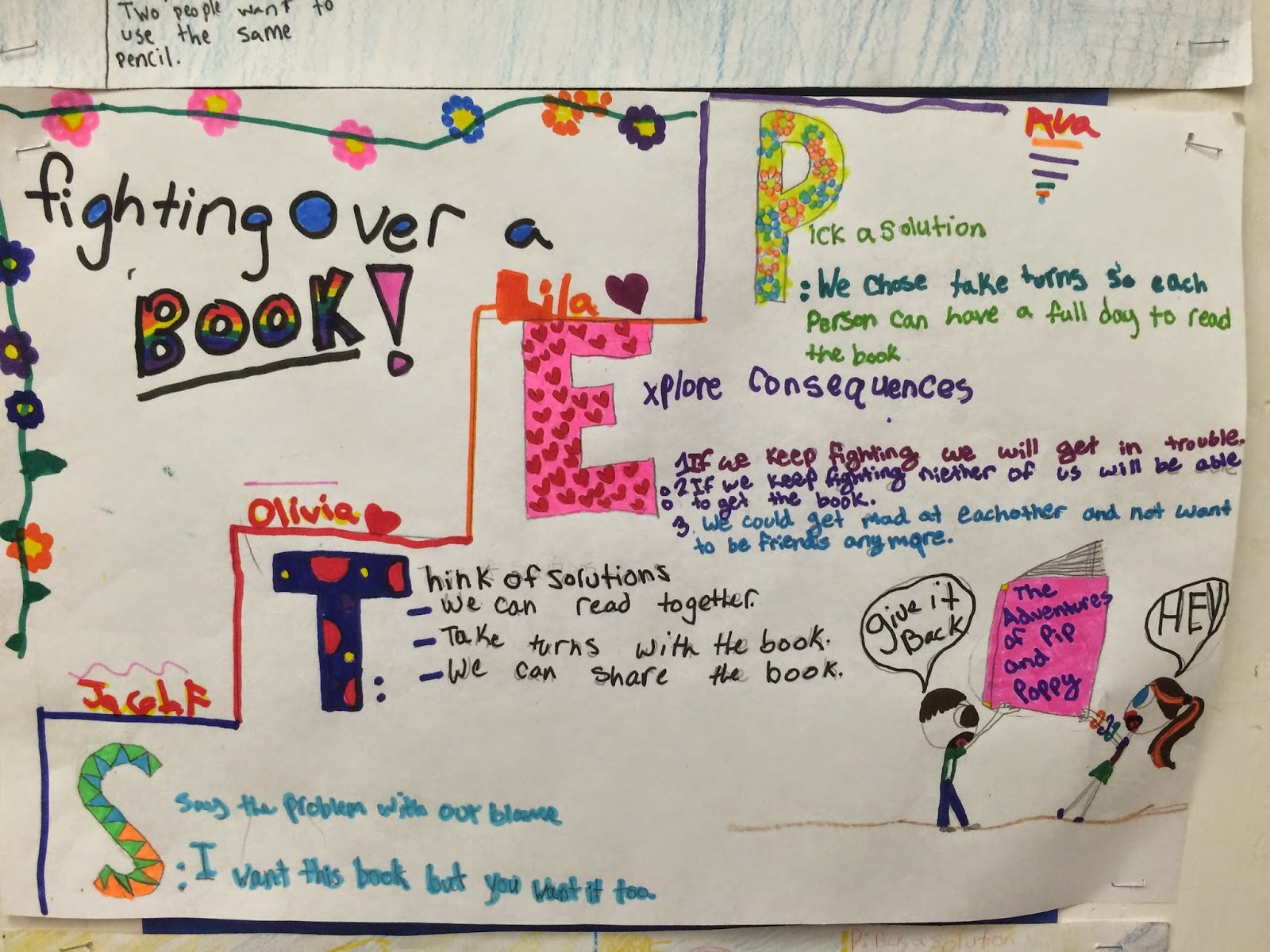
As part of our SEL curriculum through Second Step, students learn about the S.T.E.P. method for solving their everyday problems. The last 7 lessons in 4th grade are all about problem solving.
In these lessons students learn that following steps can help you solve problems and be successful at school. When you say the problem without blame and take responsibility for their part, problems can be resolved in a respectful way. Some solutions to problems are complicated and need a plan. Plans help you break down a big ask into smaller, more manageable parts. You are better able to resolve conflicts when you are able to calm down and use the Problem-Solving steps.
Students were placed into small groups and each described the steps they would use to solve common problems that occur during their school day. Here are the posters they created:
In first grade we have been working on social skills. One very important social skill is learning about friendships: what we want in a friend, how to keep friends, what we bring to a friendship, etc. I usually read the book How to Lose All Your Friends written by Nancy Carlson, but this year I found a cute video that reinforces her story. I chose to show the silent movie and I read it aloud so we could pause to discuss at different points. The students found the video hilarious and they quickly understood that this video is all the things NOT to do if you want to make and keep friends. Together we brainstormed a list of what we look for in a friend and what we bring to the table as a friend.
Then we made "Wanted" posters to show and describe what we want in a real friend. You can download the template here.
Our SEL Department developed a Peace Path that students can use in the classroom to help resolve conflict with their peers. You can take a look of how it works as part of our Peace Areas at Lee Elementary here. While this is a great tool for students to use while they're in the classroom, students are left stranded out on the playground when they have conflict. After campuses inquired about how to translate these skills to the outdoor playgrounds, our SEL department created stencils to create a sidewalk Peace Path (thank you, thank you, thank you)! Here is a quick video I took walking through the Peace Path so you can see each of the steps. It took 3-4 hours over 2 days to create the finished product with two people, myself and Joelle Andrew - an amazing parent volunteer/super hero. :)
Our playground Peace Path provides students,
teachers and our entire campus a space and a method that is safe, sincere, and
easy to follow for conflict resolution. It is another effort towards
student empowerment to self-regulate and solve their problems. Ours is
strategically placed between 2 of our playgrounds and has already been a huge hit
with the Roadrunners!
Once completed I took out each class to teach them how to use it. We began by brainstorming common problems that happen with our friends out on the playground:
I had students pair up and brainstorm a "problem" to resolve with their partner, real or fake. Then we headed outside to practice!
Our Peace Path has been a huge success! Not only are teachers on board and helping students through conflict resolution steps at recess, but children are initiating its use during our aftercare program and kids have even been caught & featured on Instagram! Here are some individual shots of each step:
In kindergarten we read You Get What You Get written by Julie Gassman. I could hardly get past reading the title without students shouting out, "And you don't throw a fit!" This short and sweet story shows how one little squirrel follows this rule at school but has a difficult time following the rule at home. He accidentally lets "the cat out of the bag" with this school rule, and his family jumps on the opportunity to implement it at home as well.
We brainstormed what fairness is and many students felt that it is everyone getting the same thing. (The blue pen represents changes we made after the different activities) I asked them if they've ever said, "That's unfair!" before and how they knew that something was unfair. We talked about our feelings that bubble up when we think something that happens isn't fair.
I then introduced a few activities to challenge their idea of fairness. I had everyone sit around in a big circle around the carpet. Then I chose 4 volunteers to create a "fishbowl" for modeling. I had them sit inside the larger circle in a smaller circle that everyone could observe. I passed out 12 different erasers unevenly (on purpose) to each of the students. Some of the students ended up with only a little and others with a lot. I asked them if the way I passed them out was fair. They had lots of qualms about how I divided it up. I asked them to redistribute the erasers in a way that they felt was fair. After many attempts, they eventually came up with a solution and we debriefed how it went.
I asked them questions such as,
What did you think of the activity?
Did you have more or less erasers then you had at the beginning?
By the end did you think it was fair?
Is it always possible to share things fairly?
I introduced the concept of compromising. What our 4 volunteers just did is called a compromise. Compromising is something we do when different people want different things. Compromise is finding a win-win solution. I asked them about a couple of scenarios to test their compromising skills:
You want to watch a cartoon, but your brother wants to watch a movie
You want to carve a scary Jack O'Lantern, but your sister wants to give it a silly face
You want to go swimming, but your friend wants to ride bikes
I then started a second activity to further expand their knowledge of fairness. This time I asked 3 volunteers to come up to the front of the room to be my actors. I told each of them that they were going to act out a different injury. The first student had a broken arm (so they held their arm with a pained look), the second student had a scratch on their arm (so they looked at that part of their arm) and the third student had a sore throat (so they coughed and asked for water). I then pulled out 3 band-aids.
I told them that I wanted things to be fair, so they were each going to get the same medical treatment. I put a band-aid on the broken arm, the scratched arm and the sore throat. Then I asked the class, was this fair? They were rolling around in laughter about how ridiculous I was. I reinforced that they said fairness means everyone getting the same thing, so I gave them each the same thing - what was wrong? After a little more discussion we came up with a compromise that fairness isn't about everyone getting the same thing, but rather everyone getting what they need. Sometimes this might mean different people will receive different things. We also learned that Ms. Sepp would not be a very good nurse. :)
Lee Elementary will be participating in The Great Kindness Challenge this week, Jan 26-30. This is one week dedicated to creating a culture of kindness
on campuses nationwide. Last year 1,099 schools participated! Lee
Elementary is proudly participating in this proactive, positive bullying
prevention initiative!
All students will receive aGreat Kindness Week
checklist with 50 kind deeds. Please encourage your child to complete
the checklist to show the world that kindness matters. If your child
completes their checklist by Friday, January 30th, have them turn it
into Ms. Sepp for a special surprise. During guidance lessons we will be reading What If Everybody Did That?, The Invisible Boy or Ordinary Mary's Extraordinary Deed to spur our conversation about kindness and paying it forward.
Then we will watch some inspirational videos... Here is a glimpse of the many amazingly kind acts that happened throughout the challenge week:
We had 100% participation and ***63 students*** complete the entire 50 kind act challenge, designating Lee Elementary as a 2015 Kindness Certified School:
 Each time spring rolls around the topic of our standardized test, STAAR, begins to enter the conversations of our students at Lee Elementary. Since we have some resident experts on the ins & outs of what the STAAR test is really like, I thought it would be a good idea for them to impart their knowledge onto our newest test takers: 3rd graders! I typed up a list of all of our 3rd graders and then our 6th graders picked 2-3 to write an encouraging letter to. They could write encouraging words, test taking tips, confidence boosters and any idea that they thought would help lower their anxiety about testing. We had a great conversation about empathy and tried to remember back to when it was our first time taking the STAAR test or even how we feel now about it. Once all of the letters were all written onto colorful bordered stationary, I put them into an "Special Delivery" envelope from the White House (also our nickname for the house beside our school that 6th grade is housed in) and delivered them to their homeroom teachers for students to receive before the test.