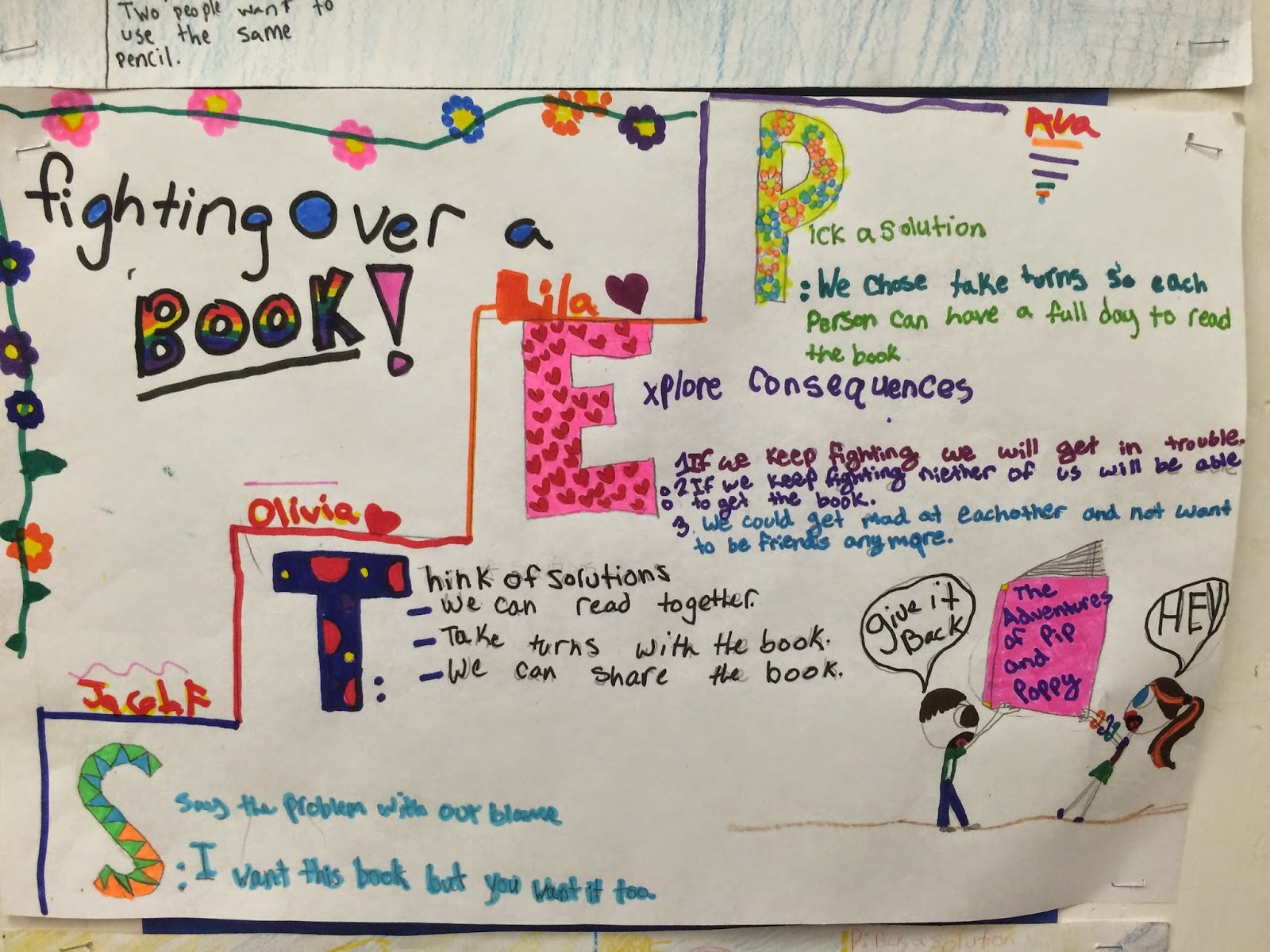
As part of our SEL curriculum through Second Step, students learn about the S.T.E.P. method for solving their everyday problems. The last 7 lessons in 4th grade are all about problem solving.
In these lessons students learn that following steps can help you solve problems and be successful at school. When you say the problem without blame and take responsibility for their part, problems can be resolved in a respectful way. Some solutions to problems are complicated and need a plan. Plans help you break down a big ask into smaller, more manageable parts. You are better able to resolve conflicts when you are able to calm down and use the Problem-Solving steps.
Students were placed into small groups and each described the steps they would use to solve common problems that occur during their school day. Here are the posters they created:
In kindergarten we read You Get What You Get written by Julie Gassman. I could hardly get past reading the title without students shouting out, "And you don't throw a fit!" This short and sweet story shows how one little squirrel follows this rule at school but has a difficult time following the rule at home. He accidentally lets "the cat out of the bag" with this school rule, and his family jumps on the opportunity to implement it at home as well.
We brainstormed what fairness is and many students felt that it is everyone getting the same thing. (The blue pen represents changes we made after the different activities) I asked them if they've ever said, "That's unfair!" before and how they knew that something was unfair. We talked about our feelings that bubble up when we think something that happens isn't fair.

I then introduced a few activities to challenge their idea of fairness. I had everyone sit around in a big circle around the carpet. Then I chose 4 volunteers to create a "fishbowl" for modeling. I had them sit inside the larger circle in a smaller circle that everyone could observe. I passed out 12 different erasers unevenly (on purpose) to each of the students. Some of the students ended up with only a little and others with a lot. I asked them if the way I passed them out was fair. They had lots of qualms about how I divided it up. I asked them to redistribute the erasers in a way that they felt was fair. After many attempts, they eventually came up with a solution and we debriefed how it went.
I asked them questions such as,
- What did you think of the activity?
- Did you have more or less erasers then you had at the beginning?
- By the end did you think it was fair?
- Is it always possible to share things fairly?
I introduced the concept of compromising. What our 4 volunteers just did is called a compromise. Compromising is something we do when different people want different things. Compromise is finding a win-win solution. I asked them about a couple of scenarios to test their compromising skills:
- You want to watch a cartoon, but your brother wants to watch a movie
- You want to carve a scary Jack O'Lantern, but your sister wants to give it a silly face
- You want to go swimming, but your friend wants to ride bikes
I then started a second activity to further expand their knowledge of fairness. This time I asked 3 volunteers to come up to the front of the room to be my actors. I told each of them that they were going to act out a different injury. The first student had a broken arm (so they held their arm with a pained look), the second student had a scratch on their arm (so they looked at that part of their arm) and the third student had a sore throat (so they coughed and asked for water). I then pulled out 3 band-aids.

I told them that I wanted things to be fair, so they were each going to get the same medical treatment. I put a band-aid on the broken arm, the scratched arm and the sore throat. Then I asked the class, was this fair? They were rolling around in laughter about how ridiculous I was. I reinforced that they said fairness means everyone getting the same thing, so I gave them each the same thing - what was wrong? After a little more discussion we came up with a compromise that fairness isn't about everyone getting the same thing, but rather everyone getting what they need. Sometimes this might mean different people will receive different things. We also learned that Ms. Sepp would not be a very good nurse. :)
In kindergarten we read My Mouth is a Volcano written by Julia Cook. Toward the beginning of the year we read another story about interrupting (see post here) but it's always a good reminder to reinforce appropriate social skills. Students enjoy this book and end up laughing at the predictable sequence that occurs each time he has a thought - words pop into his head, slide down his tongue, rumble in his tummy, get pushed by his tongue and erupt! It is only when he is interrupted by others that he starts to feel the effects and changes his behavior.
After the story we brainstormed ideas that we can try when we are about to "erupt." We wrote them erupting out of a volcano!
Then I had students pick an idea that they would try when they're about to erupt, and write it on this cute printable from Miss Gibson you can download here.
In third grade we read one of my favorite stories this week, Mr. Peabody's Apples by Madonna. Yes, Madonna!
Mr. Peabody's Apples tells the story of how one small assumption can ruin a reputation and take endless hours to fix. Students opinions of the characters in the story shift as they too believe the rumor, then learn how damaging those few words have been. After the story we discussed the following questions:
- What could Tommy have done differently when he first saw Mr. Peabody take the apple?
- What do you think the author wants us to learn from this story?
- What did you learn and how will it influence your choices?
- What does the phrase "jumping to conclusions" mean? How does that apply to this story?
- How do rumors hurt people?
I found a great activity on Fourth and Ten's blog that uses toothpaste to demonstrate the power of our words. I split students into groups, handed them a plate & tube of travel-sized toothpaste and told them that before we start the activity we are going to need to empty all the toothpaste out of the tube. We discussed working together and taking turns in order to make it a cooperative task.
Once students emptied all of the toothpaste from their tube, I then told them I wanted them to put it all back inside the tube. WHAT?!?! The ah-ha moments could be heard coming from each group. I gave them a few minutes to attempt this difficult task, then we debriefed on the purpose of the activity with our minty fresh hands. :)
Our words are like the toothpaste, we have to be careful what we say. It is not easy to take them back, just like the difficult task of trying to get the toothpaste back into the tube. Students reflected on the power of their words by filling out the following organizer from Fourth and Ten's blog.
I had students explain their learning in two ways: what I learned & positive words
One infamous request from our second grade teachers at the beginning of the school year is Tattle Tongue by Julia Cook.
This is a hilarious story that helps students recognize the differences between tattling and reporting. Through the missteps of Josh, we learn when we should speak up and when we can handle the problem on our own. We are introduced to the Tattle Prince who goes through the 4 rules for tattling - rules for tattling?!?! - yes, there are even rules for tattling. These rules and helpful charts are posted for students to use and be proactive about solving their conflicts:
Students demonstrate their knowledge of the difference between when to report and when it would be tattling by reading potential scenarios and coloring them appropriately:
Then they decorate their own Tattle Tongue bookmark to reinforce the skills:
I found a great activity on Learning to Give to help our fourth graders understand prejudice and discrimination. Many of us have misconceptions about the worlds demographics in regards to population, health, wealth, and resources. I started by giving students an activity called "If the World Were 100 People." I had students imagine that our ever-growing population of 7.1 billion people would be represented by only 100 people (roughly each 1 person would represent 70,000,000 million people - as figured out by one of our students). The handout had numbers listed up top that were to be placed next to different groupings of people. I gave them about 5-7 minutes to work on this before we went over the true results. The true answers shocked them. We discussed what surprised us most about the truth. I reinforced that if our perceptions about the world are not accurate, then how accurate are our perceptions of our own country? state? community? school? and other individuals?


People often use labels or categories to describe others. These labels might be based on clothing, looks, the way someone talks, the groups they belong to etc. Categorizing things or people is a natural behavior, however, people often make assumptions about groups of people they don't even know. I asked students to come up with some categories that we use to group people. Their answers included: nerds, blacks, whites, homeless, jocks, popular kids, gays, etc. I then challenged them to describe what a "nerd" was - how would you know someone is a nerd? They listed out some characteristics and I then further probed by asking if our assumptions we have about this group apply to everyone in the group? Do most people hold the same assumptions about a group? Why or why not? Do assumptions tell us anything definite about a categorized individual? How do our assumptions affect our behavior toward others? When we make assumptions about a group of people or a person - these are called stereotypes. Stereotypes are often unfair and hurtful. When assumptions and stereotypes influence our attitudes, we may find that it's hard to make a fair judgment about them. This is called a bias. We reviewed the list of important vocabulary which raised a rich discussion.


Finally I used the activity "Stand and Deliver". In this activity I read statements aloud that would describe something we could categorize others by: diversity, experience, etc. If the statement was true about you, you were to stand. If the statement was not true about you, you were to stay seated. This activity was done silently and after each statement was read and responded to, I had students look around the room and make observations. Statements varied from male/female, to citizenship, to birth order, to family composition, to teasing/discrimination. We debriefed by discussing the feelings that came up for us during the activity. What was the hardest part? What did you learn about yourself? What did you learn about others? What surprised you? What did this show you about discrimination?