Friday, October 18, 2013

MYOB: Mind Your Own Beeswax

The second grade teachers specially requested this lesson and I moved it to a top priority.  Second grade is a time where students begin to look outside of themselves and observe others' choices around them...and TATTLE!  Last year Julia Cook's A Bad Case of Tattle Tongue was a huge hit so I gave it another try.


It chronicles a typical day in Josh's life.  He tattles on everyone, even his dog.  His mother gets fed up with his tattling and warns him that he'll catch tattle tongue if he continues to tattle on others.  The next day at school he hears about a bully threatening to beat up Edith, a friend of his.  Josh remembers what his mom said and chooses not to say anything...which in this case would have been reporting.  The Tattle Prince visits him later that night to go over the "tattle rules" - yes, there are tattle rules - with him.


Students learn the difference between tattling and warning/reporting by following these 4 simple rules.  To reinforce this concept, we created our own tattle tongue bookmarks using tongue depressors, sharpies, glue and glitter.


Students evaluated and determined which situations would be tattling and which would be reporting/warning by color-coding the spots on a tongue.  


I also posted 2 helpful posters in each of the 2nd grade classrooms for students to refer to if they were stuck.


Thursday, October 17, 2013

First Graders Are Filling Our Buckets


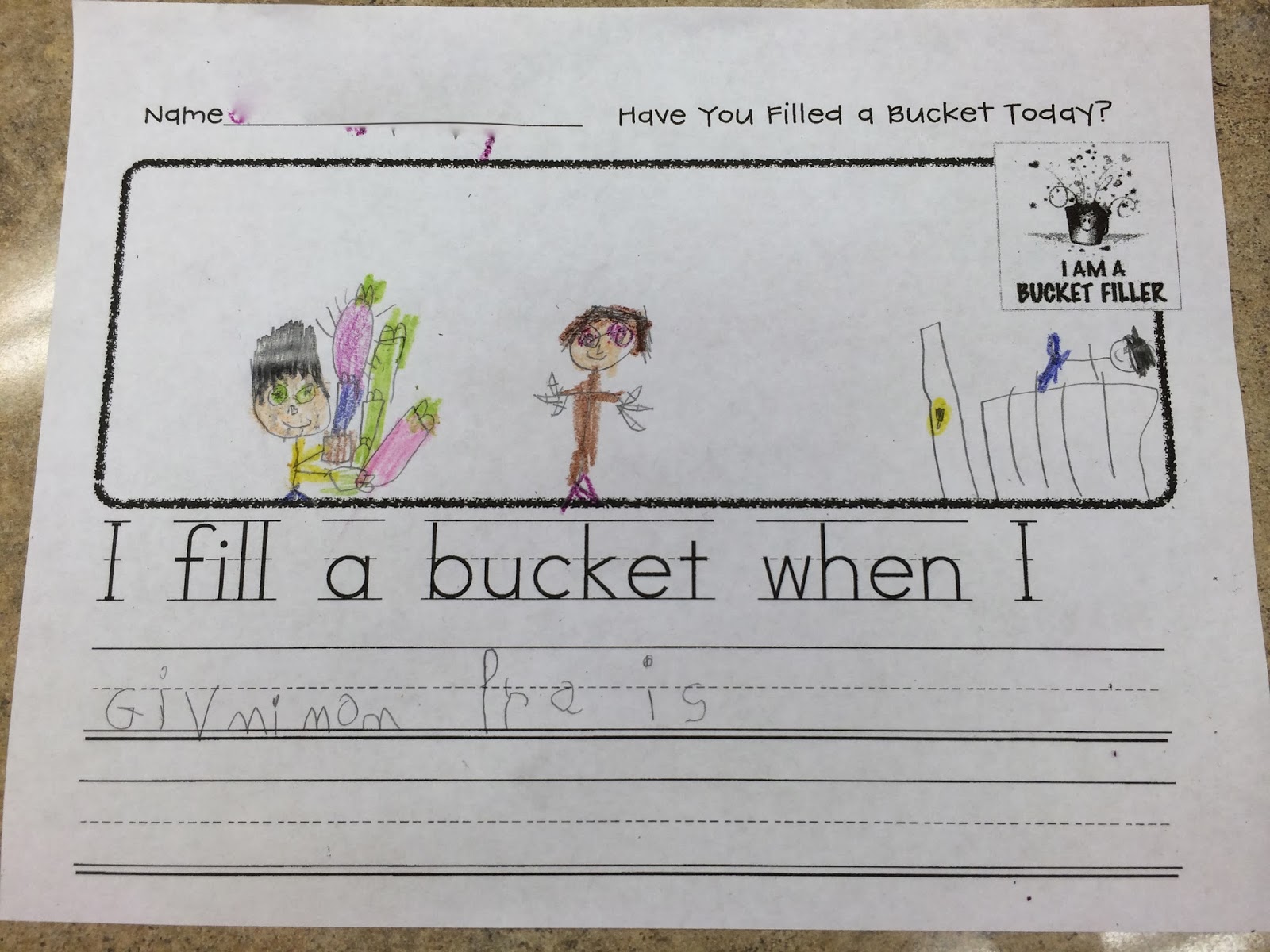
I reread one of my favorite books to share at the beginning of the year, Have You Filled a Bucket Today? written by Carol McCloud!  Even though my first graders experienced this book when they were kindergarteners, I thought it was a great way for them to connect to our upcoming Character Counts! Week.


They were full of observations, connections, and ideas while I read the book...I could hardly turn the page!  Afterward we shared how we can be bucket fillers by illustrating a picture and writing a sentence describing their kindness toward others.  Click each thumbnail below to see their creative ideas!


Wednesday, October 16, 2013

Warning: I Have a Feeling Bubbling Up

Over the last few weeks we've been discussing feelings in kindergarten.  I took it a step further this week by bringing attention to the warning signals our bodies give us.  It's important to not only understand our feelings, but also to know how to recognize what our body feels like during different feelings.  I shared with students a large poster labeled with a variety of warning signs we might feel in our body when we are experiencing a strong emotion.  We went through each of these and modeled some of them together to remember how it feels.  Students even added some of their own warning signals they experience in their body during a strong feeling.  By knowing our bodies, we can self-soothe and use self control to be appropriate in public when we are furious, saddened, disappointed, lonely, etc.


I then had students evaluate how which warning signals they experience in their bodies during strong feelings.  I gave them each a chart with 5 feelings and a sheet full of the warning signals we reviewed on the chart.  They looked at each feeling and paired it with the warning signal their body gives off.  Finally they cut it out and glued it to their paper.  I walked around to aid in the process, but for the most part they were very aware of how their bodies responded to strong feelings and we found that we are each unique.  


Sticks and Stones: Brain Releases Natural Painkillers During Social Rejection

Check out this fascinating article I just read from Science Daily:


"Sticks and stones may break my bones, but words will never hurt me," goes the playground rhyme that's supposed to help children endure taunts from classmates. But a new study suggests that there's more going on inside our brains when someone snubs us -- and that the brain may have its own way of easing social pain.


The findings, recently published in Molecular Psychiatry by a University of Michigan Medical School team, show that the brain's natural painkiller system responds to social rejection -- not just physical injury.

What's more, people who score high on a personality trait called resilience -- the ability to adjust to environmental change -- had the highest amount of natural painkiller activation.
The team, based at U-M's Molecular and Behavioral Neuroscience Institute, used an innovative approach to make its findings. They combined advanced brain scanning that can track chemical release in the brain with a model of social rejection based on online dating. The work was funded by the U-M Depression Center, the Michigan Institute for Clinical and Health Research, the Brain & Behavior Research Foundation, the Phil F Jenkins Foundation, and the National Institutes of Health.

They focused on the mu-opioid receptor system in the brain -- the same system that the team has studied for years in relation to response to physical pain. Over more than a decade, U-M work has shown that when a person feels physical pain, their brains release chemicals called opioids into the space between neurons, dampening pain signals.
David T. Hsu, Ph.D., the lead author of the new paper, says the new research on social rejection grew out of recent studies by others, which suggests that the brain pathways that are activated during physical pain and social pain are similar.

"This is the first study to peer into the human brain to show that the opioid system is activated during social rejection," says Hsu, a research assistant professor of psychiatry. "In general, opioids have been known to be released during social distress and isolation in animals, but where this occurs in the human brain has not been shown until now."
The study involved 18 adults who were asked to view photos and fictitious personal profiles of hundreds of other adults. Each selected some who they might be most interested in romantically -- a setup similar to online dating.

But then, when the participants were lying in a brain imaging machine called a PET scanner, they were informed that the individuals they found attractive and interesting were not interested in them.

Brain scans made during these moments showed opioid release, measured by looking at the availability of mu-opioid receptors on brain cells. The effect was largest in the brain regions called the ventral striatum, amygdala, midline thalamus, and periaqueductal gray -- areas that are also known to be involved in physical pain.

The researchers had actually made sure the participants understood ahead of time that the "dating" profiles were not real, and neither was the "rejection." But nonetheless, the simulated social rejection was enough to cause both an emotional and opioid response.

Suffering slings and arrows differently
Hsu notes that the underlying personality of the participants appeared to play a role in how much of a response their opioid systems made.

"Individuals who scored high for the resiliency trait on a personality questionnaire tended to be capable of more opioid release during social rejection, especially in the amygdala," a region of the brain involved in emotional processing, Hsu says. "This suggests that opioid release in this structure during social rejection may be protective or adaptive."
The more opioid release during social rejection in another brain area called the pregenual cingulate cortex, the less the participants reported being put in a bad mood by the news that they'd been snubbed.

The researchers also examined what happens when the participants were told that someone they'd expressed interest in had expressed interest in them -- social acceptance. In this case, some brain regions also had more opioid release. "The opioid system is known to play a role in both reducing pain and promoting pleasure, and our study shows that it also does this in the social environment," says Hsu.

The new research holds more importance than just pure discovery, note the authors, who also include senior author Jon-Kar Zubieta, M.D., Ph.D., a longtime opioid researcher. Specifically, they are pursuing further research on how those who are vulnerable to, or currently suffering from depression or social anxiety have an abnormal opioid response to social rejection and/or acceptance. "It is possible that those with depression or social anxiety are less capable of releasing opioids during times of social distress, and therefore do not recover as quickly or fully from a negative social experience. Similarly, these individuals may also have less opioid release during positive social interactions, and therefore may not gain as much from social support," Hsu theorizes.

Hsu also notes that perhaps new opioid medications without addictive potential may be an effective treatment for depression and social anxiety. Although such medications are not yet available, he adds, "increasing evidence for the neural overlap of physical and social pain suggests a significant opportunity to bridge research in the treatment of chronic pain with the treatment of psychiatric disorders."

If nothing else, perhaps knowing that our response to a social snub isn't "all in our heads" can help some people understand their responses and cope better, Hsu says. "The knowledge that there are chemicals in our brains working to help us feel better after being rejected is comforting."

Monday, October 14, 2013

Lee Mediators - Part 1

This fall I will be training all of our fifth graders to be Peer Mediators using the Peers Making Peace curriculum.  Once students are trained, I will allow them to sign-up to help younger students on our campus with conflict resolution, under my supervision.


I started with a discussion of what conflict means.  Students brainstormed synonyms and we were able to come up with a working definition that conflict ultimately means "a disagreement."  It can be anything from an argument to a fight to a war.


I then asked them,
  • "Who in this room has ever had a conflict?"
  • "Who are some of the people we have conflict with?"
  • "What are some of the things we have conflict about?"
With conflict fresh in our minds, I had them describe the feelings that come up when dealing with conflict in their lives.  It was easy to find a common theme amongst the feelings, they are all negative feelings.  Most often in conflict we find there is a winner and a loser.


I then asked students, "If we could change conflict to be win/win, do you think the feelings might be more positive?"  Mediation does exactly that and I will be training you to do this!  I shared some scary statistics that have appeared in the news over the last year of students handling conflict in a lose/lose battle.  This charged up our mission to help other students at Lee handle conflicts!

I will be teaching them about conflict and new skills for dealing with conflict, communication skills and the process of mediation.  They will help our school become a better place by helping students talk about their conflicts, thus reducing fights at our school and helping students find a positive way for solving their problems.

I also sent home a parent note explaining the program:


This year, fifth graders at Lee Elementary will be trained as peer mediators, “Lee Mediators.”  Recognizing that young people are competent to participate in the resolution of their own disputes encourages student growth and gives students skills such as listening, critical thinking, and problem solving that are basic to all learning.  Mediation training, with its emphasis upon listening to others’ points of view and the peaceful resolution of differences, assists in preparing students to live in a multicultural world.  Also by shifting the responsibility for solving appropriate school conflicts from adults to students, it frees teachers to concentrate more on teaching than on discipline.  

Conflict is a natural human state that often accompanies change.  It is better approached with skills than by avoidance.  The use of mediation in school-based disputes can improve communication between and among students, teacher, administrators and parents.  It can improve the school climate and provide a forum for addressing common concerns.  Medication training helps both students and teachers broaden their understanding about themselves and others and provides them with a lifetime of dispute-resolution skills.  Mediation training also increases students’ interest in conflict resolution, justice, and the American legal system while encouraging a higher level of citizenship activity. 

Students will learn about

  • conflict and new skills for dealing with conflict,
  • communication skills,
  • process of mediation
  • and how to help in making Lee a better place

I will be training our fifth graders this fall and upon the completion of training they will be available for mediations between students and others interested in resolving their conflicts in a nonviolent manner, under my supervision.  Please let me know if you have any questions about this program.

Friday, October 11, 2013

SQUIRREL: Distractions in Our Day


Just as Doug, the talking dog in Pixar's "Up!", experiences distractions in his life - so do all of us in our daily lives.  According to this study completed by ars technica and published in the New York Times, it can take up to 15 minutes to get your mind back on track after you've been distracted.  That's a lot of wasted time!  My goal for this lesson was to help third graders identify which daily distractions interrupt their school work and how we can be proactive in eliminating them.

I began by reading the hilarious book, This Morning Sam Went to Mars written by Nancy Carlson.  This is a fun real aloud that visually grabs students and puts them in the middle of Sam's wild imagination.  After struggling to pay attention in life, Sam's dad and doctor help him come up with strategies to work on being more successful each day.


Then the fun began.  I brought in Ned.  Who is Ned you might ask?  Ned is originally from the game, "What's in Ned's Head?"  I took this large "head" and filled it with common distractions that occur throughout the school day, such as lawnmowers, friends sharpening a pencil, etc.

 (This is Ned)


Students loved seeing me reach into his ears and his nose to pull out the next distraction.  As I revealed each card, we discussed whether or not this is a distraction that we create inside our brains or is it a distraction in our environment.  We added our decisions to a chart to organized our thinking:


Once the distractions were organized, we talked about what we have control over (ourselves) and what we do not have control over (everything else).  Although we don't have control over our environment, there are some strategies we can use to lessen their interruption (ask them to stop, use kelso's choices, switch seats, etc.)  We then brainstormed ways to blast these distractors out of our minds and refocus: