
Showing posts with label therapy techniques. Show all posts
Showing posts with label therapy techniques. Show all posts
Monday, February 9, 2015

Wednesday, November 19, 2014
Practicing Our Peace Path
One way students can resolve conflict is by using the Peace Path. The Peace Path is a 7 step process that guides children through effective conflict resolution with peers. Students complete each step in the process before moving to the next, with each peer completing their part. You can download a copy of it here.


The Peace Path follows the STEP method that our students are introduced to during their Second Step SEL Lessons. Each student is given an opportunity to express how they feel and what they need/want. Their peer shows empathy and understanding by rewording their feelings and wants/needs.

In order to illustrate how quick and easy it is to use, I asked our Principal and Assistant Principal to model the Peace Path for students to watch.
Afterward I had students pick a problem to practice using the path themselves.


The Peace Path follows the STEP method that our students are introduced to during their Second Step SEL Lessons. Each student is given an opportunity to express how they feel and what they need/want. Their peer shows empathy and understanding by rewording their feelings and wants/needs.
In order to illustrate how quick and easy it is to use, I asked our Principal and Assistant Principal to model the Peace Path for students to watch.
Afterward I had students pick a problem to practice using the path themselves.
Monday, September 29, 2014
Donors Choose

I want to make sure my students have the materials they need to succeed. So I’ve created a classroom project request at DonorsChoose.org, an award-winning charity.
I’m asking for donations of any size to help my kids. For the next four days, any donation you make to my project will be doubled (up to $100). If you know anyone who is passionate about education, please pass this along. Your donation will brighten my students’ school year, and you’ll get photos and thank yous from our class.
Here’s my 2 classroom requests:
http://www.donorschoose.org/project/the-d-word/1369235/?rf=email-system-2014-09-teacher_promo_expiring-teacher_2533801&challengeid=20478511/
http://www.donorschoose.org/project/social-skills-savvy/1358774/?rf=email-system-2014-09-teacher_promo_expiring-teacher_2533801&challengeid=20478511/
To have your donation matched dollar for dollar, enter the promo code INSPIRE on the payment screen. This awesome match offer lasts through October 2.
My students and I greatly appreciate your support.
Ms. Sepp

Saturday, September 20, 2014

Monday, August 25, 2014
A Quick Photo Tour of My Office
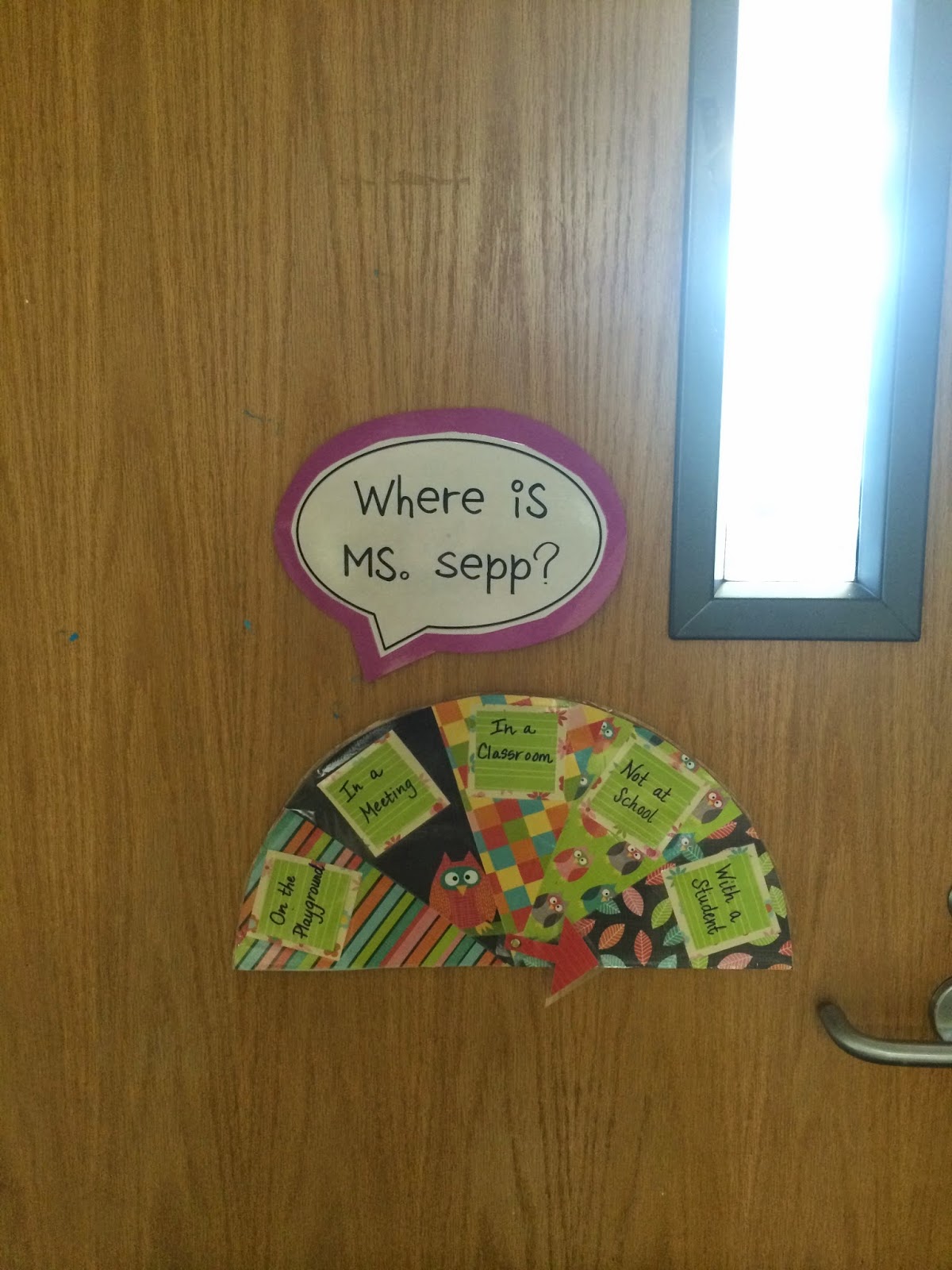
This is my 3rd year as school counselor at Lee Elementary. Each year I revamp my space to accommodate our students needs by gathering new supplies and reorganizing materials for student ease. Here are some quick snapshots of the space:


Saturday, March 15, 2014
The Power of Teamwork

Once a group of 500 people were attending a seminar. Suddenly the speaker stopped and decided to do a group activity. He started giving each person a balloon. Each person was then asked to write their name on it using a marker pen. Then all the balloons were collected and put in another room.
The people were then let into that room and asked to find the balloon which had their name written on it within 5 minutes. Everyone was frantically searching for their name, colliding with each other, pushing around others and there was utter chaos.
At the end of 5 minutes no one could find their own balloon.
Then, the speaker asked each person to randomly collect a balloon and give it to the person whose name was written on it. Within minutes everyone had their own balloon.
The speaker then began, "This is happening in our lives. Everyone is frantically looking for happiness all around, not knowing where it is.
Our happiness lies in the happiness of other people. Give them their happiness; you will get your own happiness. And this is the purpose of human life...the pursuit of happiness."
Thank you for sharing Brett Dyer!!!
Saturday, March 8, 2014
Beyond “Do your best”
Beyond “Do your best”: Three Ways to Lessen Your Child’s Anxiety about School
I really enjoyed reading this article from Positive Parenting Solutions, written by Dr. Kevin L. Gyoerkoe. The strategies he focuses on are excellent ways to lower anxiety in our overwhelmed children. Enjoy!
"When I first started working with 12 year-old Sarah*, she was the picture of anxiety. Sticking close to her mom, her hair covering her face, she sat in the waiting room as I came out to say hello. She muttered a “hi”, and we walked back to my office. We talked for a few minutes about movies, then–knowing her parents had brought her to my office because of her anxiety about grades–I asked her about school. Sarah burst into tears as she described just how anxious she felt.
“I feel like I have to be perfect; I have to make straight A’s”, she told me. “I don’t know when to stop, I study all the time. It takes me so much longer to finish my homework than my friends. And if I get a B or worse, I freak out.”
Toward the end of our meeting, I asked Sarah’s mom to come into my office. Her mom was calm and relaxed, the exact opposite of Sarah. She smiled easily and sat comfortably on the couch. She seemed genuinely puzzled by Sarah’s worries about school and anxiety about her grades.
“We don’t know where she gets it”, Sarah’s mom explained. “We never put any pressure on her to get good grades. All that we ask is that she do her best.”
As a psychologist who specializes in treating anxiety, I’ve witnessed this scene play out many times over the past 13 years. At first, when I met with patients like Sarah, I expected that their parents would be hard-driving, achievement-oriented moms and dads who demanded perfection and straight A’s. The first few times parents like Sarah’s mom breezed into my office more relaxed and low-key than most, I thought it was a fluke.
Over time, however, a predictable pattern emerged. These relaxed parents, it seemed, often shared the same approach when parenting their children: all we ask is that you just do your best.
As this pattern appeared, I started to wonder: Could the innocent sounding, low-key, “just do your best” approach actually make a child feel more anxious? As I considered this paradox, it occurred to me that there were three key reasons why telling someone to do their best could actually increase anxiety:
- It creates uncertainty: One problem with the well-intentioned do your best is that it’s simply too vague. How do we know when we’ve done our best? There’s no way to measure that goal or track our progress, so we are left in a state of uncertainty.
- Uncertainty creates anxiety: Uncertainty is a common cause of anxiety. Often, the more unsure we are about something, the more anxious we feel about it.
- It can cause us to personalize negative events: When negative events occur, it’s natural to try to explain why. If we’re instructed to just do our best on a task, and we don’t do well, we are likely to blame ourselves and conclude that we are inadequate or incompetent in some way. This creates a sense of defeat and hopelessness, which could lead to less effort and resilience in the future.
- Be specific: Instead of the vague “do your best”, help your child set clear, concrete goals to lessen anxiety and develop good work habits. For example, you might suggest that your child to take three mock spelling tests before her weekly spelling quiz. Or you could encourage her to practice multiplication flash cards until she can do them with 100% accuracy. Being specific on the steps required to do well allows our children to shift their focus away from the outcome and focus on the process instead.
- Focus on mastery: Paradoxically, you can lessen your child’s anxiety and improve school performance by encouraging focus on mastery of the material instead of how much effort they put in. For example, if your child is strong in math, it may take just a few minutes of practice and little effort to master the multiplication tables for the week. Once he’s achieved this goal, consider it mission accomplished, regardless of how hard he tried or if he “did his best”.
- Problem-solve: If your child receives a low grade, instead of asking “Did you do your best?” ask “What do you need to do to do better next time?” Consider it a learning experience and review the material with your child. What does your child need to brush up on? Evaluate study habits as well. Did she practice regularly? Was all the homework complete? Look beyond just the grades themselves and evaluate your child’s work habits. Do they need to improve? Remember, all the effort in the world won’t overcome bad habits. By the same token, a few small shifts in work habits can make effort much more efficient.
To learn more about helping your child overcome anxiety, visit www.anxietyandocdtreatmentcenter.com.
*Sarah is a fictional patient created to represent a composite of many children with similar problems."
Thursday, March 6, 2014
Be A Noble Kid Feature

I want to share a big Thank You to Be A Noble Kid! I recently discovered that one of my blog articles had been featured in January on their website: beanoblekid.org. This is an informative website with a powerful mission for our younger generations:

I recommend checking out their blog for more amazing ideas. Here is the link to my article on Self-Control.
Thursday, December 12, 2013
Huffington Post Article: Anxiety
I came across this very informative article about anxiety in children written by Daniel B. Peters, Ph.D. for the Huffington Post:

Anxiety has become a regular part of our society and daily lives for our children (and ourselves). Worry and fear cause our children to feel bad, often cause parent-child conflict and stress, keep our children from fully experiencing life, and fully reaching their potential. As a psychologist, parent of worriers, and a pretty good worrier myself, I have learned that there are simple and effective strategies that kids (and parents) can learn to drive the Worry Monster away. Teaching kids about how fear and worry work in their bodies, and specific thinking and doing strategies to fight the Worry Monster, empowers them to take a stand against this bully.
It's time for us to take the Worry Monster down once and for all and turn our worriers into warriors.
Here are the 10 steps to do it:
Step 1: Teach How Our Brain and Body Work When We Are Scared
We all have a "fight or flight" survival response that is designed to keep us alive. We have a tiny ball of neurons called the amygdala (ah-mig-da-la), known as our fear center, that runs our in-body security system. When it senses danger, it sends adrenaline through our bodies to make us run fast and fight with one goal, survival!
Step 2: Identify Body Feelings
When your amygdala gets activated, you will feel the physical sensations of worry and fear in your body, especially your head, chest, stomach, and throat. This is because your heart has to beat super fast to get extra blood from your brain and stomach to your arms and legs so you can fight and run fast. The blood leaving our brain and stomach makes us feel light headed, have headaches, have stomachaches, butterflies, and make us nauseous. These feelings are our signal that the Worry Monster is messing with us! Any of them sound familiar?
Step 3: Externalize the Problem
Label your worries and fears as the "Worry Monster" who is a bully who is responsible for making you (and all of us) think worrisome and scary thoughts. The Worry Monster's job is to keep us from enjoying life. He gets joy from picking on children (and adults) and making them worried and scared. The more you talk about the Worry Monster and gang up on him with your allies, the weaker he will get and the sooner he will go away.
Step 4: Make a Worry List
Make a list of everything your child (and you) worries about. The Worry Monster doesn't like us to talk about him or how he works, so the more things you put on the list, the better. Once you have done this, put the worries and fears in order starting with the most powerful (severe) at the top and least powerful (mild) at the bottom of the list.
Step 5: Make a Success Ladder
Choose a behavior from the worry list and make a success ladder by breaking it down into baby steps, or rungs, with the ultimate fear or goal at the top of the ladder and the least scary behavior at the bottom. You will need to decide whether you can start with a single fear like swimming or whether the task needs to be broken into parts (looking at a pool) so that you can gain confidence by becoming used to each baby step along the way to conquering your fear.
Step 6: Identify Worrisome and Fearful Thinking
Think about what the Worry Monster tells you to make you feel worried and scared. Take out your worry list, and expose the Worry Monster's secrets by writing down what he tells you to make you feel scared and worried. For example, next to the worry "being left alone," you may write, "I might get left at school." Uncover what he tells you for all your worries and fears -- you are exposing him.
Step 7: Change and Modify Thinking
Next to the list of what the Worry Monster tells you, write down new thoughts that are healthier and more realistic. Ask yourself, "What am I thinking? How can I think about this differently?" For example, "I might get left at school," gets changed to, "I have never been left before" and "Something bad might happen to my mom," gets changed to, "My mom is strong and can take care of herself."
Step 8: Practice, Practice, Practice!
Choose behavioral practice activities to tackle the Worry Monster head on. Go to your Success Ladder and start doing the first thing on the bottom of the list until you are bored of it. For example, if you are afraid of dogs, look at a book about dogs until it is not scary and then go to the next rung on the ladder (looking at dogs from far away). Keep moving up the ladder and work your way to the top. Sometimes it goes quickly and other times you may have to practice something over and over.
Step 9: Develop a Coping Toolbox
Make a personalized toolbox to help you take on the Worry Monster when he shows up. This toolbox usually consists of strategies like deep breathing, understanding where in your body you feel the worry and fear, knowing what makes you start worrying or feeling scared, questions to ask yourself to challenge your thinking ("Is it true?), statements to use against the Worry Monster ("I can do this!"; "Take a hike, you cowardly bully!"; "So what?"), exercise, and activities that distract you and help you relax.
Step 10 -- Don't Give Up!
Like all bullies, the Worry Monster does not give up easily. It takes a ton of courage and persistence to drive him away. You have talents to show the world and lots of life experiences to enjoy. By using these strategies, and working as a team, the Worry Monster doesn't stand a chance. It is time for him to pick on somebody else. Don't give up. You are a warrior. You can do this!

Anxiety has become a regular part of our society and daily lives for our children (and ourselves). Worry and fear cause our children to feel bad, often cause parent-child conflict and stress, keep our children from fully experiencing life, and fully reaching their potential. As a psychologist, parent of worriers, and a pretty good worrier myself, I have learned that there are simple and effective strategies that kids (and parents) can learn to drive the Worry Monster away. Teaching kids about how fear and worry work in their bodies, and specific thinking and doing strategies to fight the Worry Monster, empowers them to take a stand against this bully.
It's time for us to take the Worry Monster down once and for all and turn our worriers into warriors.
Here are the 10 steps to do it:
Step 1: Teach How Our Brain and Body Work When We Are Scared
We all have a "fight or flight" survival response that is designed to keep us alive. We have a tiny ball of neurons called the amygdala (ah-mig-da-la), known as our fear center, that runs our in-body security system. When it senses danger, it sends adrenaline through our bodies to make us run fast and fight with one goal, survival!
Step 2: Identify Body Feelings
When your amygdala gets activated, you will feel the physical sensations of worry and fear in your body, especially your head, chest, stomach, and throat. This is because your heart has to beat super fast to get extra blood from your brain and stomach to your arms and legs so you can fight and run fast. The blood leaving our brain and stomach makes us feel light headed, have headaches, have stomachaches, butterflies, and make us nauseous. These feelings are our signal that the Worry Monster is messing with us! Any of them sound familiar?
Step 3: Externalize the Problem
Label your worries and fears as the "Worry Monster" who is a bully who is responsible for making you (and all of us) think worrisome and scary thoughts. The Worry Monster's job is to keep us from enjoying life. He gets joy from picking on children (and adults) and making them worried and scared. The more you talk about the Worry Monster and gang up on him with your allies, the weaker he will get and the sooner he will go away.
Step 4: Make a Worry List
Make a list of everything your child (and you) worries about. The Worry Monster doesn't like us to talk about him or how he works, so the more things you put on the list, the better. Once you have done this, put the worries and fears in order starting with the most powerful (severe) at the top and least powerful (mild) at the bottom of the list.
Step 5: Make a Success Ladder
Choose a behavior from the worry list and make a success ladder by breaking it down into baby steps, or rungs, with the ultimate fear or goal at the top of the ladder and the least scary behavior at the bottom. You will need to decide whether you can start with a single fear like swimming or whether the task needs to be broken into parts (looking at a pool) so that you can gain confidence by becoming used to each baby step along the way to conquering your fear.
Step 6: Identify Worrisome and Fearful Thinking
Think about what the Worry Monster tells you to make you feel worried and scared. Take out your worry list, and expose the Worry Monster's secrets by writing down what he tells you to make you feel scared and worried. For example, next to the worry "being left alone," you may write, "I might get left at school." Uncover what he tells you for all your worries and fears -- you are exposing him.
Step 7: Change and Modify Thinking
Next to the list of what the Worry Monster tells you, write down new thoughts that are healthier and more realistic. Ask yourself, "What am I thinking? How can I think about this differently?" For example, "I might get left at school," gets changed to, "I have never been left before" and "Something bad might happen to my mom," gets changed to, "My mom is strong and can take care of herself."
Step 8: Practice, Practice, Practice!
Choose behavioral practice activities to tackle the Worry Monster head on. Go to your Success Ladder and start doing the first thing on the bottom of the list until you are bored of it. For example, if you are afraid of dogs, look at a book about dogs until it is not scary and then go to the next rung on the ladder (looking at dogs from far away). Keep moving up the ladder and work your way to the top. Sometimes it goes quickly and other times you may have to practice something over and over.
Step 9: Develop a Coping Toolbox
Make a personalized toolbox to help you take on the Worry Monster when he shows up. This toolbox usually consists of strategies like deep breathing, understanding where in your body you feel the worry and fear, knowing what makes you start worrying or feeling scared, questions to ask yourself to challenge your thinking ("Is it true?), statements to use against the Worry Monster ("I can do this!"; "Take a hike, you cowardly bully!"; "So what?"), exercise, and activities that distract you and help you relax.
Step 10 -- Don't Give Up!
Like all bullies, the Worry Monster does not give up easily. It takes a ton of courage and persistence to drive him away. You have talents to show the world and lots of life experiences to enjoy. By using these strategies, and working as a team, the Worry Monster doesn't stand a chance. It is time for him to pick on somebody else. Don't give up. You are a warrior. You can do this!
Wednesday, October 16, 2013
Warning: I Have a Feeling Bubbling Up
 Over the last few weeks we've been discussing feelings in kindergarten. I took it a step further this week by bringing attention to the warning signals our bodies give us. It's important to not only understand our feelings, but also to know how to recognize what our body feels like during different feelings. I shared with students a large poster labeled with a variety of warning signs we might feel in our body when we are experiencing a strong emotion. We went through each of these and modeled some of them together to remember how it feels. Students even added some of their own warning signals they experience in their body during a strong feeling. By knowing our bodies, we can self-soothe and use self control to be appropriate in public when we are furious, saddened, disappointed, lonely, etc.
I then had students evaluate how which warning signals they experience in their bodies during strong feelings. I gave them each a chart with 5 feelings and a sheet full of the warning signals we reviewed on the chart. They looked at each feeling and paired it with the warning signal their body gives off. Finally they cut it out and glued it to their paper. I walked around to aid in the process, but for the most part they were very aware of how their bodies responded to strong feelings and we found that we are each unique.


Friday, October 11, 2013
SQUIRREL: Distractions in Our Day

Just as Doug, the talking dog in Pixar's "Up!", experiences distractions in his life - so do all of us in our daily lives. According to this study completed by ars technica and published in the New York Times, it can take up to 15 minutes to get your mind back on track after you've been distracted. That's a lot of wasted time! My goal for this lesson was to help third graders identify which daily distractions interrupt their school work and how we can be proactive in eliminating them.
I began by reading the hilarious book, This Morning Sam Went to Mars written by Nancy Carlson. This is a fun real aloud that visually grabs students and puts them in the middle of Sam's wild imagination. After struggling to pay attention in life, Sam's dad and doctor help him come up with strategies to work on being more successful each day.

Then the fun began. I brought in Ned. Who is Ned you might ask? Ned is originally from the game, "What's in Ned's Head?" I took this large "head" and filled it with common distractions that occur throughout the school day, such as lawnmowers, friends sharpening a pencil, etc.

(This is Ned)

Students loved seeing me reach into his ears and his nose to pull out the next distraction. As I revealed each card, we discussed whether or not this is a distraction that we create inside our brains or is it a distraction in our environment. We added our decisions to a chart to organized our thinking:

Once the distractions were organized, we talked about what we have control over (ourselves) and what we do not have control over (everything else). Although we don't have control over our environment, there are some strategies we can use to lessen their interruption (ask them to stop, use kelso's choices, switch seats, etc.) We then brainstormed ways to blast these distractors out of our minds and refocus:

Wednesday, September 25, 2013


Wednesday, September 11, 2013

Monday, September 9, 2013
Group Therapy at Austin Child Guidance Center
Here is information about upcoming groups at ACGC,
Group therapy is conducted both at our Center and offsite. The purpose of group therapy is to help children develop skills for positive peer interaction. This is accomplished by providing insight on reaching consensus and handling conflict, as well as encouraging young people to talk about their feelings through appropriate means of expression instead of screaming, fighting, or withdrawing. The group also provides feedback for the children about how other children perceive them.
The following groups are being offered for the fall of 2012. Each group lasts 8 weeks and meets once a week. ACGC has a low cost sliding fee scale for the groups. Call 512-451-2242 to inquire about and sign up for any of these groups.
Mondays, starting 9/30/2013 - Social Skills Group (6-9 year olds)
The group is based on the program Children’s Friendship Training by Fred Frankel and Robert Myatt. The program has been found to be effective in helping kids make and keep friends. Topics include how to carry on a two-way conversation, approach others to play, be a good host, and show good sportsmanship. The group is appropriate for kids with ADHD, Autism Spectrum Disorder or any who struggle with understanding and using positive friendship skills.
Thursdays, starting 10/3/2013, 6-7:30 PM – Conflict Resolution Skills / Anger Management (9-12 year olds)
The children in the anger management group will participate in activities that correspond to that week’s topic. The issues presented will cover: identifying triggers to anger, taking responsibility for mistakes, learning positive coping skills, exploring feelings that may be underneath anger, and making good choices through problem solving steps. Our activities will focus on establishing trust within the group, developing solutions to common problems, exploring consequences, and practicing how to diffuse a heated situation. Kids who anger easily, have difficulty with peer relationships because of anger, or struggle with impulsiveness would benefit from this group.
Tuesdays, starting 9/3/2013, 6-7:30 PM, ADHD Parenting Group (for parents of children 5-12 year olds)
This group has multiple objectives. Members will work to improve parenting skills for children’s behavioral problems. It will raise parents’ knowledge about causes of defiant behavior. The group will work to increase children’s compliance with commands and rules. Lastly, concepts will help improve family life through positive attention, consequences, rule-setting, and appropriate discipline.
Friday, September 6, 2013
New Student Picnics
At the beginning of each school year I like to host New Student Picnics for are our Lee Newbies. This year we had 29 new friends that joined our community! I typically do these the second week of school to allow new students to get settled before I start pulling them from their lunchtime.

 I sent out invitations to each new student at the end of the first week of school. Each day I hosted picnics for two grade levels to allow me enough time to meet with two groups. For example, I met with 1st grade & 4th grade on the same day because their lunches were 45 minutes apart. This gave me enough time to tidy up before the next group came.
I used colorful bulletin board paper as a table cloth and cut up a large bowl of oranges each day for them to enjoy. The purpose of the picnics is to help new students identify a support network in their new setting. We practiced friendship skills, identified things they had in common with other new students, and became familiar with the rules and expectations of Lee Elementary. After 3 days of picnics I had made many new friends!
We also discussed the following questions to open up and get to know each other a little better:
Check out last years post about our new student picnics here.

 I sent out invitations to each new student at the end of the first week of school. Each day I hosted picnics for two grade levels to allow me enough time to meet with two groups. For example, I met with 1st grade & 4th grade on the same day because their lunches were 45 minutes apart. This gave me enough time to tidy up before the next group came.
I used colorful bulletin board paper as a table cloth and cut up a large bowl of oranges each day for them to enjoy. The purpose of the picnics is to help new students identify a support network in their new setting. We practiced friendship skills, identified things they had in common with other new students, and became familiar with the rules and expectations of Lee Elementary. After 3 days of picnics I had made many new friends!
We also discussed the following questions to open up and get to know each other a little better:
- How many schools have you gone to before coming to Lee?
- What do you miss about your old school?
- What is one thing that has helped you feel welcome at Lee?
- What is the hardest part about moving?
- What is something you are excited about for this year?
Check out last years post about our new student picnics here.
Wednesday, September 4, 2013
My Counseling Corner
I am extremely lucky to have such a snazzy space at my school! I really did luck out, it's spacious and bright! :) I created unique spaces to facilitate group counseling, individual counseling, talk therapy, play therapy, art therapy, conferences with parents and a cool down area...


Subscribe to:
Posts (Atom)